Quick answer
What is the difference between endometriosis and fibroids? Fibroids are lumps of muscle tissue that grow in or on the womb and are almost never cancer, according to ACOG. Endometriosis is tissue similar to the womb lining growing outside the womb, most often on the ovaries, the fallopian tubes and the lining of the pelvis, according to the Mayo Clinic. The symptoms overlap, but the two are separate conditions.
Fibroids are muscle lumps that grow in or on the womb. Endometriosis is tissue like the womb lining that grows outside it. Both can bring heavy, painful periods, so they are easy to mix up, and you can have both.
Endometriosis or fibroids?
Not sure which it is?
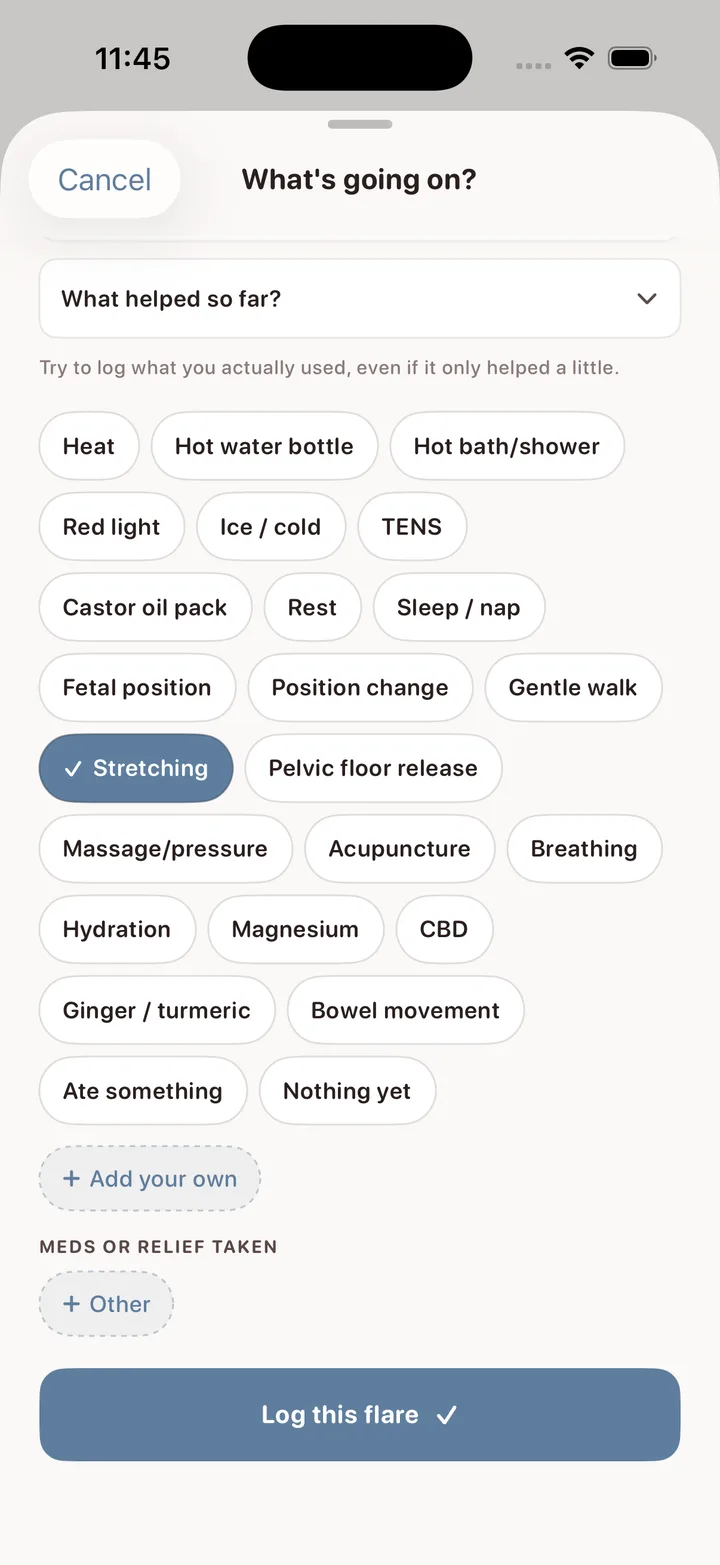
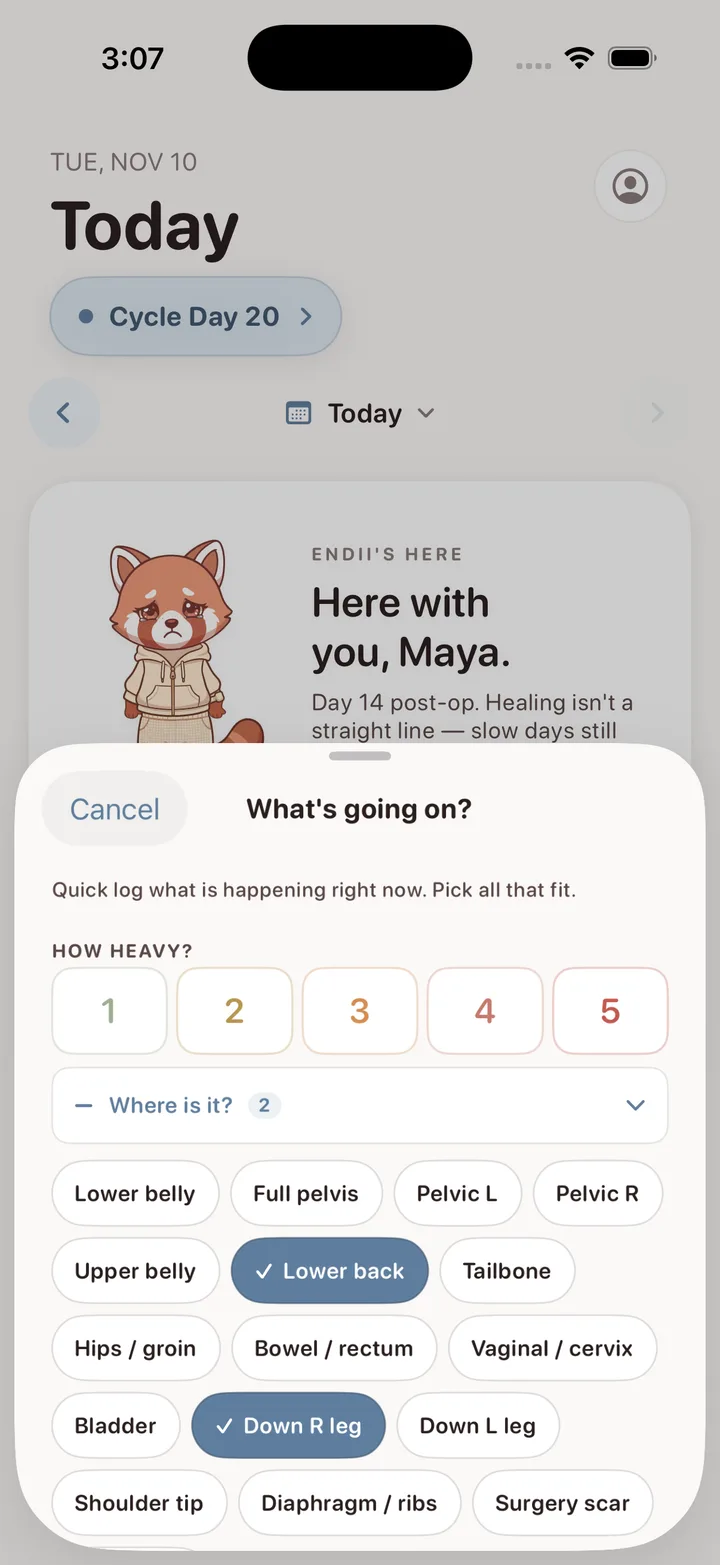
Endii keeps a daily log of your pain, bleeding and cycle day that you can show your doctor.
Two different conditions
Fibroids are growths of muscle tissue in the womb. ACOG1, the US body for obstetricians and gynecologists, calls them benign, meaning not cancer, and says they are the most common type of growth found in a woman's pelvis. They are also called leiomyomas or myomas. There can be one or many, from the size of a pea to large enough to fill the pelvis.
Endometriosis is where cells similar to those in the lining of the womb grow in other parts of the body, in the words of the NHS2. The Mayo Clinic3 says it often affects the ovaries, the fallopian tubes and the tissue lining the pelvis.
Both are common. The US Office on Women's Health4 says about 20 to 80 percent of women develop fibroids by age 50, and many never know. The World Health Organization5 estimates that endometriosis affects about 10 percent of women of reproductive age worldwide.
Where each one grows
Where does each one grow?
This is the biggest difference. A fibroid is part of the womb itself. The Cleveland Clinic6 names four kinds by where they sit:
- In the wall of the womb. The most common kind.
- Under the inner lining, bulging into the space inside the womb.
- Under the outer surface, sometimes growing out into the pelvis.
- On a stalk, attached to the womb like a mushroom. The least common kind.
Endometriosis grows outside the womb. Most of it is superficial, the Mayo Clinic says, so it cannot be seen without surgery. Sometimes it grows into organs such as the bowel or bladder.
How the symptoms compare
Which symptoms are shared?
Many of the symptoms are the same. The NHS lists heavy or painful periods, lower back pain, pain during sex, bowel problems and difficulty getting pregnant for fibroids7, and most of the same list for endometriosis.
A few differ in how they are described:
- Fibroids often press. ACOG1 groups some fibroid symptoms under pressure: needing to pee often, constipation, and a dull, heavy, aching pain in the tummy or lower back. The Mayo Clinic8 adds a growing stomach area. Large fibroids can make someone look pregnant.
- Endometriosis often hurts around your period. The Mayo Clinic3 says the main symptom is pelvic pain, often starting before a period and lasting days into it, and pain with bowel movements or peeing that is most likely before or during a period. The NHS also lists pain after sex and extreme tiredness.
- Fibroids often cause nothing at all. ACOG and the Mayo Clinic both say many people with fibroids have no symptoms and only find out during an exam or a scan for something else. Where they do cause symptoms, the Mayo Clinic says the location, size and number of fibroids make a difference.
Age can be a clue too. ACOG says fibroids are most common between 30 and 40, and the Cleveland Clinic says they are rare before a first period. Speaking to the Mayo Clinic News Network9, Dr Megan Wasson, chair of gynecology at Mayo Clinic in Arizona, said endometriosis symptoms usually start much earlier in life than fibroids.
Heavy periods, pressure, pain? Note them by cycle day in Endii, so the pattern is ready for your appointment. Free for 14 days, then a subscription.
Get EndiiWhy they get mixed up
Three reasons come up in the sources.
- The symptoms overlap. A 2021 review10 by researchers in Oulu and Oxford says the two have markedly different causes and natural history, but their symptoms can overlap, so telling them apart often needs a laparoscopy.
- The tests see them differently. The NHS says an ultrasound scan can show fibroids, how many there are, where they are and how big. For endometriosis it lists an ultrasound, an MRI or a laparoscopy, and says the laparoscopy is what can confirm it. A clear scan for fibroids does not rule out endometriosis.
- They often come together. More on that below.
Endometriosis is also mixed up with other conditions. The Mayo Clinic names pelvic inflammatory disease, ovarian cysts and irritable bowel syndrome. The 2021 review also counts a third condition, adenomyosis, which it also finds alongside fibroids.
Can you have both?
Can you have both?
Yes. The 2021 review describes considerable overlap between the two and gathers the studies that have measured it. Their results vary a lot:
- In a hospital in Oulu, Finland, about 26 in 100 women with endometriosis also had fibroids, against about 9 in 100 women without endometriosis. Going the other way, about 20 in 100 women with fibroids had endometriosis, against about 6 in 100 without fibroids.
- An Italian study from 1994 found endometriosis in 12 in 100 women with fibroids.
- Two smaller studies at US centres, in 2010 and 2016, found endometriosis in 86 to 87 in 100 women with fibroids.
The numbers differ because the studies looked at different groups of patients in different ways. What they agree on is that the two often turn up together. The review also says the genetic roots of both are not fully understood, though recent evidence suggests some shared ground. Dr Wasson notes that both can run in families.
How each one is treated
The treatments differ because the conditions differ. This is what the health bodies describe; the right choice depends on your symptoms and plans, and is one to make with a doctor.
- Fibroids. The NHS7 says fibroids that cause no symptoms do not always need treatment. When they do, options include medicines for heavy bleeding and pain, surgery to remove the fibroids and keep the womb (a myomectomy), a hysterectomy, and a procedure that blocks the blood supply to the fibroids so they shrink (uterine artery embolization). ACOG1 adds radiofrequency ablation, which uses heat to shrink them.
- Endometriosis. The Mayo Clinic News Network says treatment often involves medication or surgery, including surgery that removes endometriosis tissue while keeping the womb and ovaries.
Hormonal birth control appears on both lists, for different reasons. ACOG says it can help with heavy bleeding and pain from fibroids, and notes it may make fibroids grow slightly larger. For endometriosis, see our guide to birth control for endometriosis.
What to write down
What to jot down for your doctor
You do not need to work out which one it is. That is the doctor's job, and often the scan's. What helps is a clear record. The NHS says to see a GP if fibroid symptoms affect your everyday life or painkillers are not helping, and says endometriosis can take a long time to diagnose.
Dr Wasson's advice, given to the Mayo Clinic News Network, is to pay attention to unusually heavy periods, cycles that are too long or too short, and pain with periods, from the time periods start.
Questions to bring to your doctor
- Could my symptoms be fibroids, endometriosis, or both?
- Would an ultrasound show what is going on, or might I need another test?
- If the scan is clear, what would the next step be?
- Which of my symptoms would you like me to keep track of, and for how long?
How Endii helps
Endii was built by a woman with endometriosis who was tired of needing three apps to manage one condition.
- Daily log: pain, bleeding and symptoms in a few taps, with your cycle day saved alongside.
- Insights: your symptoms lined up by cycle day, so patterns are easier to spot.
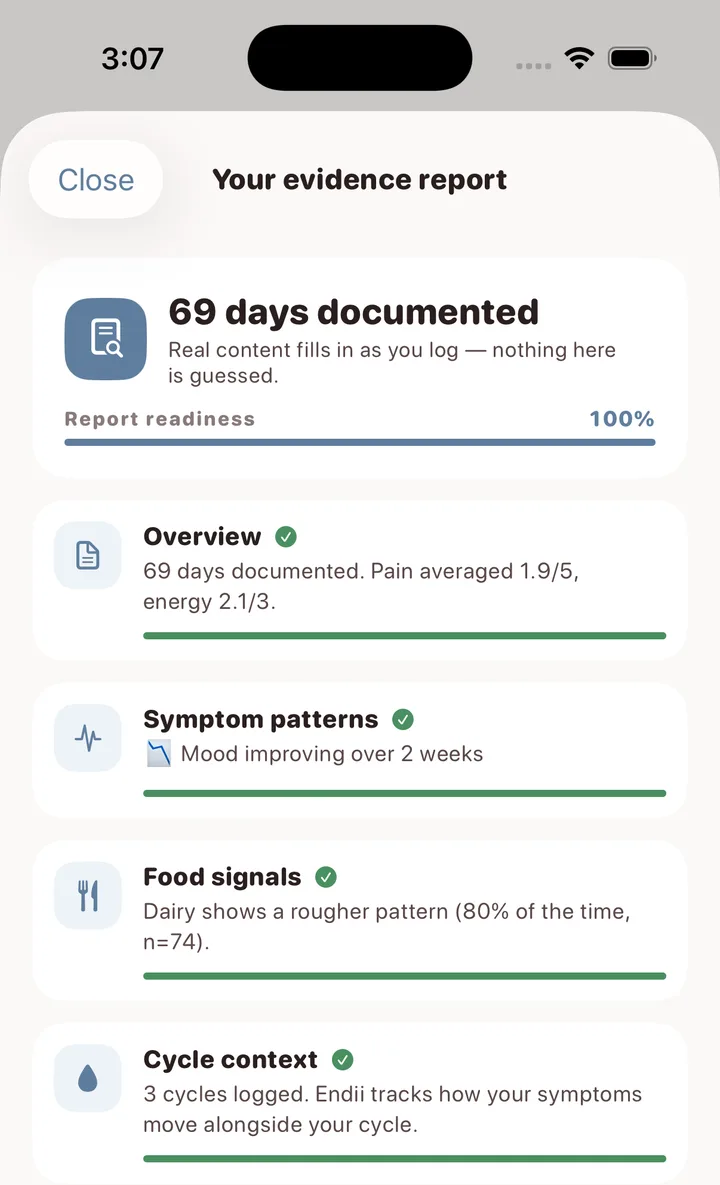
- Doctor report: a clear PDF of your symptoms and patterns to take to an appointment.
Bring a clear record to your appointment.
Endii comes with a 14-day free trial.
Related guides
Sources
- American College of Obstetricians and Gynecologists (ACOG). Uterine fibroids: frequently asked questions. acog.org
- NHS. Endometriosis. nhs.uk
- Mayo Clinic. Endometriosis: symptoms and causes. mayoclinic.org
- US Office on Women's Health. Uterine fibroids. womenshealth.gov
- World Health Organization. Endometriosis: fact sheet (15 October 2025). who.int
- Cleveland Clinic. Uterine fibroids. my.clevelandclinic.org
- NHS. Fibroids. nhs.uk
- Mayo Clinic. Uterine fibroids: symptoms and causes. mayoclinic.org
- Mayo Clinic News Network, 11 June 2026. Endometriosis and fibroids: expert explains advances giving women less invasive treatment options. newsnetwork.mayoclinic.org
- Uimari O, Nazri H, Tapmeier T. Frontiers in Reproductive Health, 2021. Endometriosis and uterine fibroids (leiomyomata): comorbidity, risks and implications. pubmed.ncbi.nlm.nih.gov
Sources last checked on 18 November 2026. We link to the page each statement comes from so you can read it in full.
Endii is a tracking journal, not medical advice. It does not diagnose or treat any condition. This page is sourced, not reviewed by a clinician. Symptoms cannot tell fibroids and endometriosis apart; only a doctor and the right tests can. Always talk to a qualified doctor about your symptoms and before making medical decisions. In an emergency, contact emergency services.