Quick answer
What are the symptoms of skin endometriosis? DermNet describes a firm lump under the skin that can cramp and bleed during your period, often blue, black, brown or red, with itching, swelling or tenderness. In a 2026 review of 484 cases after a C-section, 96 in 100 people had pain and 94 in 100 had a lump they could feel.
Skin endometriosis usually shows up as a firm lump in a scar, most often from a C-section, or in the belly button. It tends to swell, hurt or bleed around your period, and it is rare.
Where does it show up?
A lump that changes with your period?
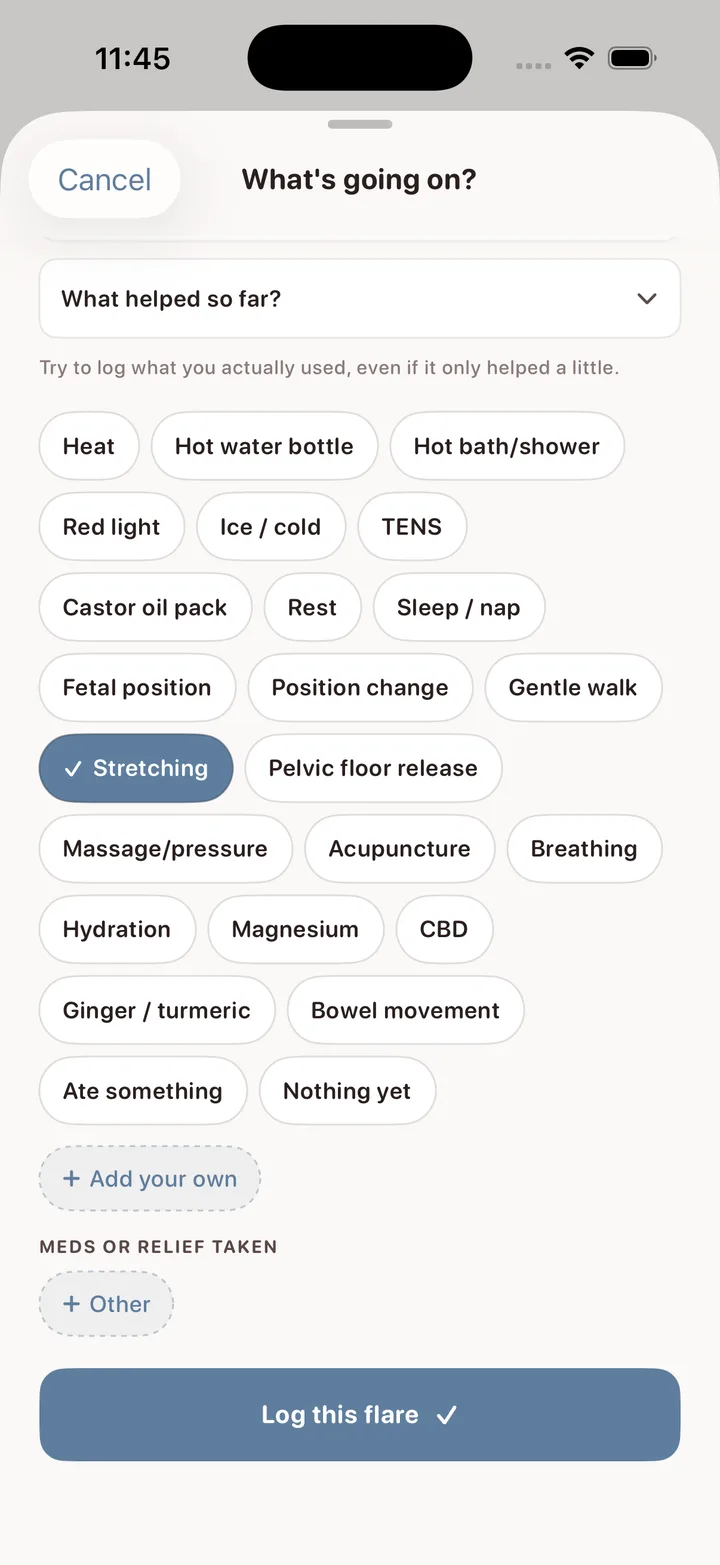
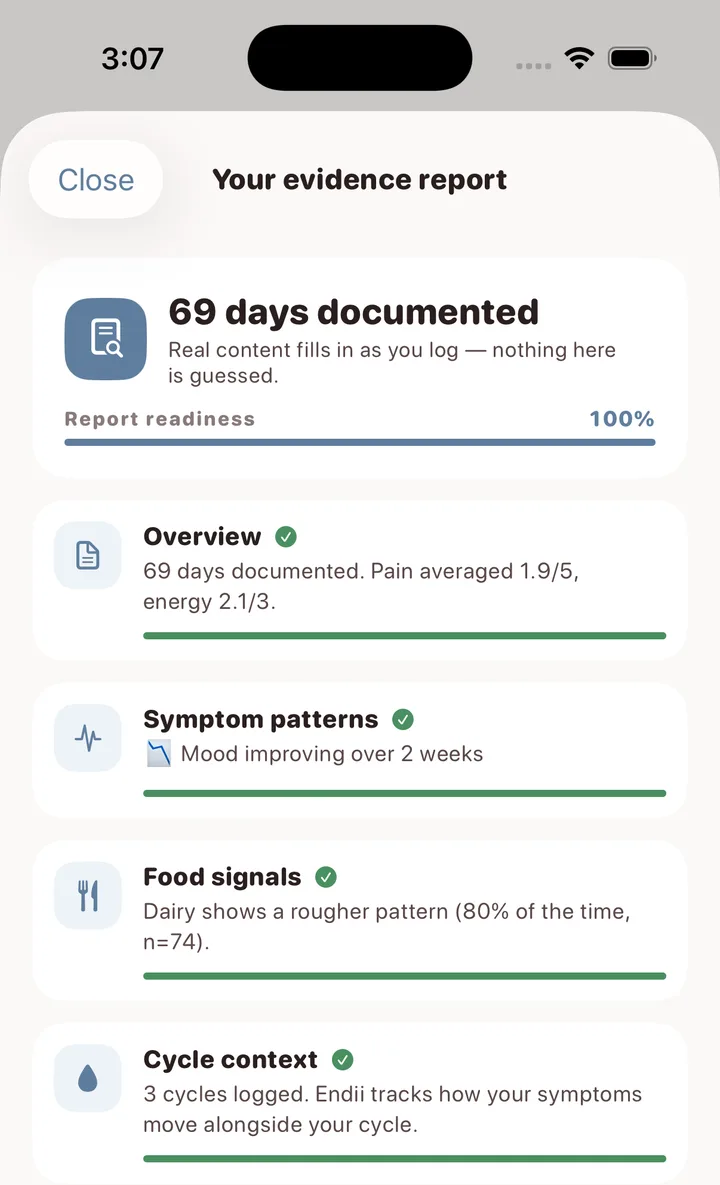
Endii keeps a daily log of your symptoms and cycle day, so you can show a doctor what it does all month.
What skin endometriosis is
Endometriosis is where cells similar to those in the lining of the womb grow in other parts of the body, in the words of the NHS1. Most often that is inside the pelvis. Skin endometriosis, also called cutaneous endometriosis or scar endometriosis, is when that tissue grows in the skin or just under it.
It is rare. DermNet, the New Zealand skin resource, says endometriosis outside the pelvis happens in about 12 in 100 women with endometriosis, and the skin is one of the less common places. A 2019 review by dermatologists at the University of California, San Francisco, says skin cases make up less than 1 in 100 of all endometriosis cases in large studies.
There are two kinds:
- Secondary, the more common kind, grows in a surgery scar. DermNet names C-sections, hysterectomies and keyhole (laparoscopic) surgery.
- Primary appears with no surgery to explain it. The 2019 review puts it at about 30 in 100 cases, most often in the belly button.
What it looks and feels like
What did people notice?
DermNet describes a lump under the skin that:
- is usually firm
- can be blue, black, brown or red; the 2019 review adds purple and skin-coloured
- can cramp, swell and bleed during your period, which is why it is sometimes called a "menstruating tumour", a nickname that does not mean it is a cancer
- can itch or feel tender
Not everyone notices the link with their period. A 2008 review of 445 cases in the American Journal of Surgery found 96 in 100 people had a lump and 87 in 100 had pain, but only 57 in 100 had symptoms that came and went with their cycle. A 2017 review from the Medical University of South Carolina adds that some people have no symptoms at all.
After a C-section
How long after a C-section?
The C-section scar is the place it is found most often. In the 2008 review, 57 in 100 cases were linked with a C-section scar and 11 in 100 with a hysterectomy. The 2017 review gives an incidence of about 2 to 8 in 1,000 C-sections.
A 2026 review by researchers at the University of Milan pooled 484 cases after a C-section from 158 studies:
- the median age at diagnosis was 33
- symptoms started a median of 26 months after the C-section
- it was diagnosed a median of 48 months after it
- 96 in 100 had pain and 94 in 100 a lump they could feel
- only about 9 in 100 had been diagnosed with endometriosis before
That last number matters. Many people with a C-section scar lump have never had endometriosis anywhere else. The review authors expect it to become more common as C-section rates rise. A 2021 review of 260 cases after a C-section describes it as a risk that is easy to forget.
Noticed a lump in your scar? Note its size and the days it swells or hurts in Endii, so the pattern is ready for your appointment. Free for 14 days, then a subscription.
Get EndiiWhat else a scar lump can be
Is this lump endometriosis?
Skin endometriosis is often mistaken for something else at first. DermNet says diagnosis is often delayed because it looks like a bruise (haematoma), a nerve lump (neuroma), a hernia or a growth. The 2017 review lists the others doctors think about after a C-section:
- a bruise under the skin, which is tender but does not change with your cycle
- a lump from an injection
- a stitch lump (suture granuloma)
- a keloid, a raised scar that grows past the edges of the wound
- a desmoid tumour, which grows slowly but usually without pain that follows the cycle
- an incisional hernia, where tissue pushes through the scar
The 2017 review says the most useful clues are a past C-section, the scan findings and pain that follows the cycle.
How it is found
DermNet lists the steps a doctor may take:
- questions about your periods and past surgery
- an exam of the lump
- an ultrasound, sometimes with Doppler to look at blood flow
- a CT or MRI scan, mostly to rule out other things and see how deep it goes
- a small sample, with a fine needle or a skin biopsy
The sample is what confirms it. DermNet and the 2019 review say a diagnosis is made when the tissue under the microscope shows the glands and supporting tissue of the womb lining. The 2017 review notes that how the lump looks on a scan can depend on where you are in your cycle.
How it is treated
This is what the sources describe. Which treatment is right is a decision for you and a doctor.
- Surgery to cut the lump out is the main treatment, say DermNet and the 2019 review, which adds wide margins around it. The 2008 review found surgery cured it more than 95 times in 100, and it came back in about 4 in 100. The 2026 review found it came back in about 5 in 100.
- Hormone medicines are another option, DermNet says. The 2019 review says the drawback is that the tissue may start growing again once they stop.
DermNet says that, rarely, a lump like this can turn into a cancer, and to think of that if it is very large, grows fast or comes back after removal.
Can endometriosis affect your skin in other ways?
Some people with endometriosis also describe itchy skin, eczema or acne around their period. This is separate from skin endometriosis, and the sources do not agree on how they are linked.
### What the health bodies say.
The NHS1 lists severe period pain, heavy periods, pain in the lower tummy and back, pain when you poo or pee, pain during or after sex, extreme tiredness and difficulty getting pregnant. It does not list itchy skin, eczema or acne. Apart from lumps in scars or the belly button, the skin sources on this page do not describe skin changes as a sign of endometriosis.
### The other view.
The Seckin Endometriosis Center in New York, led by surgeon Tamer Seckin, argues that endometriosis can be linked to other skin problems:
- Endometriosis patches hold many mast cells, immune cells that release histamine. The centre says too much histamine can show up as eczema, with dry, itchy skin.
- It says hormonal changes may lead to acne around the start of a period.
- It points to a 2014 study of 88,623 nurses in the US Nurses' Health Study II, which found that women who had severe acne as teenagers had a 20% higher risk of endometriosis later confirmed by surgery.
The centre also says pelvic endometriosis itself is not the cause of these skin changes. Its view is that the same underlying biology may make both more likely.
### Why the official position has not changed.
- The studies show things turning up together, not one causing the other. The 2014 acne study says so in its own words: it found an association. Its authors also note that the nurses were mostly white, which limits how far it applies.
- Eczema went the other way in one study. The Seckin page links a 2021 study of 551 people with endometriosis and 652 without as showing a link with eczema. That study found higher odds of endometriosis in people with allergies, but lower odds in people with eczema, and that result was not certain.
- No health body on this page lists skin changes as a symptom. Until larger studies say more, the symptoms the NHS lists are the ones doctors look for.
| The other view | The health bodies | |
|---|---|---|
| Who | The Seckin Endometriosis Center | The NHS and the skin sources on this page |
| Itchy skin, eczema | May be linked through histamine | Not listed as a symptom |
| Acne | Linked in a 2014 study of 88,623 nurses | An association, not a cause |
| Lumps in a scar or belly button | Skin endometriosis | Skin endometriosis |
Both sides agree on the lumps. On other skin changes, the question is open.
What to write down
What to note about the lump
You do not need to know what the lump is. What helps a doctor is knowing what it does when they are not looking at it.
DermNet says the lump can cramp and bleed during your period, and the 2017 review says the cyclical pain is one of the most useful clues. A few weeks of notes, with the size, the colour and the days it swells, hurts or bleeds, makes that pattern easy to show. Add the date of any C-section or other surgery, since the 2026 review found symptoms often start about two years after it. See what endometriosis can feel like for words that help describe pain.
Questions to bring to your doctor
- Could this lump be endometriosis, or something else in the scar?
- Would an ultrasound or a small sample help tell?
- If it is endometriosis, how deep does it go, and what are the options?
- Should I be checked for endometriosis inside the pelvis too?
- What would you like me to keep track of before the next visit?
How Endii helps
Endii was built by a woman with endometriosis who was tired of needing three apps to manage one condition.
- Daily log: pain, bleeding and symptoms in a few taps, with your cycle day saved alongside.
- Insights: your symptoms lined up by cycle day, so patterns are easier to spot.
- Doctor report: a clear PDF of your symptoms and patterns to take to an appointment.
Bring a clear record to your appointment.
Endii comes with a 14-day free trial.
Related guides
Sources
- NHS. Endometriosis. nhs.uk
Sources last checked on 10 November 2026. We link to the page each statement comes from so you can read it in full.
Endii is a tracking journal, not medical advice. It does not diagnose or treat any condition. This page is sourced, not reviewed by a clinician. A lump cannot be identified from symptoms alone; only a doctor and the right tests can say what it is. A lump that grows fast, bleeds without a pattern or comes back after removal needs a doctor promptly. In an emergency, contact emergency services.