Quick answer
What is the difference between endometritis and endometriosis? Endometritis is an infection or inflammation of the lining inside the womb, and antibiotics usually treat it, according to the Cleveland Clinic. Endometriosis is tissue similar to the womb lining growing outside the womb, often on the ovaries, the fallopian tubes and the lining of the pelvis, according to the Mayo Clinic. MedlinePlus says plainly that endometritis is not the same as endometriosis.
Endometritis is an infection or inflammation of the lining inside the womb, and antibiotics usually clear it. Endometriosis is tissue like that lining growing outside the womb, and it has no cure. The names are one syllable apart; the conditions are not.
Endometritis or endometriosis?
Not sure what your pain is telling you?
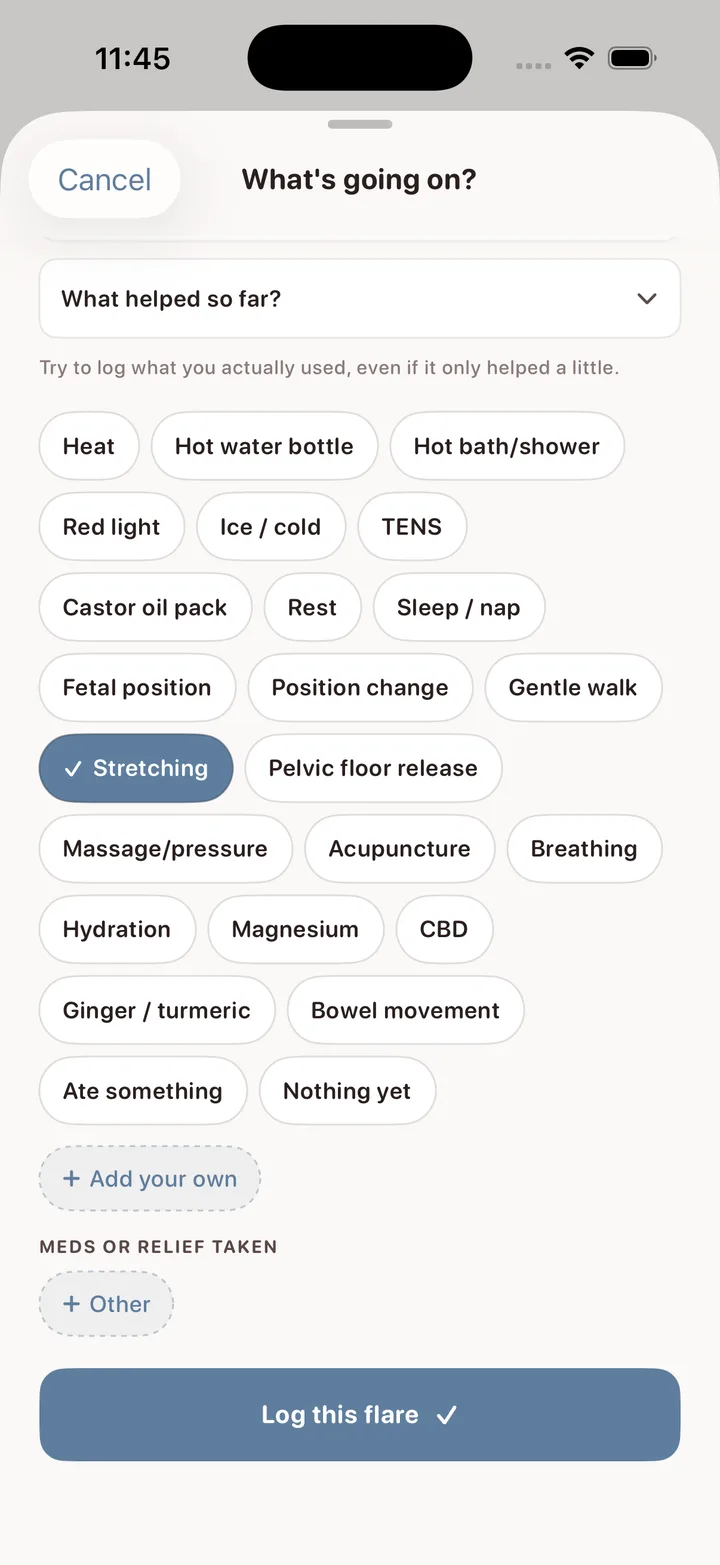
Endii keeps a daily log of your pain, bleeding and cycle day that you can show your doctor.
Two different conditions
Endometritis is inflammation of the endometrium, the lining of the womb, caused by an infection, says the Cleveland Clinic1. It comes in two kinds:
- Acute endometritis starts suddenly and lasts a short time. It can happen after a birth, a miscarriage, or surgery on the womb or cervix.
- Chronic endometritis lasts a long time. The Cleveland Clinic says it is more common after menopause or with an infection such as chlamydia or gonorrhea.
Endometriosis is where cells similar to those in the lining of the womb grow in other parts of the body, in the words of the NHS2. The Mayo Clinic3 says it often affects the ovaries, the fallopian tubes and the tissue lining the pelvis.
MedlinePlus4, from the US National Library of Medicine, opens its endometritis page by saying it is not the same as endometriosis. The names share a root because both involve the womb lining. That is where the likeness ends.
Where each one happens
Where does each one happen?
Endometritis happens inside the womb. It is the lining itself that becomes infected or inflamed.
Endometriosis happens outside the womb. The tissue looks like the lining but grows where it should not, most often on the ovaries, the tubes and the lining of the pelvis, the Mayo Clinic says.
What causes each one
Endometritis is caused by bacteria. The Cleveland Clinic says bacteria get into the womb most often after a birth or a procedure on the womb or cervix, less often through a sexually transmitted infection, and sometimes from bacteria that normally live in the vagina. MedlinePlus adds tuberculosis to the list and names the procedures that raise the risk:
- a birth, more often after a C-section than a vaginal birth
- a miscarriage
- a D and C (a procedure to remove tissue from the womb)
- a biopsy of the womb lining
- a hysteroscopy (a camera passed into the womb)
- having an IUD fitted
How often it follows a birth depends on the kind of birth. The MSD Manual5 gives about 1 in 100 vaginal births, 3 in 100 planned C-sections, and 5 to 10 in 100 C-sections done after labor has started.
The cause of endometriosis is not known. The NHS says so plainly, and there is no infection to clear.
How the symptoms compare
When does it usually start?
Some symptoms overlap: both can cause pain low in the tummy, unusual bleeding and pain when you poo. The differences are in what comes with the pain and when it comes.
- Endometritis often comes with signs of infection. The Cleveland Clinic lists fever, unusual or bad-smelling discharge and feeling unwell, along with pain and irregular or heavy bleeding. After a birth, the MSD Manual says the first signs are usually pain low in the tummy and a tender womb, then a fever, most often within one to three days.
- Endometriosis pain often follows your cycle. The Mayo Clinic says the main symptom is pelvic pain that is often linked with periods. The NHS also lists heavy periods, pain during or after sex, pain when you poo or pee, and extreme tiredness.
- Chronic endometritis can be quiet. A 2025 review6 says it often causes no symptoms at all, or mild ones such as irregular bleeding, pelvic discomfort, pain during sex or more discharge. Irregular bleeding is the most common.
MedlinePlus says to call a doctor right away if symptoms of endometritis come after a birth, a miscarriage, an abortion, an IUD fitting or surgery on the womb.
Pain, bleeding, a fever? Note them with the date and your cycle day in Endii, so the pattern is ready for your appointment. Free for 14 days, then a subscription.
Get EndiiHow each one is found
The tests differ because one is inside the womb and the other is outside it.
- Endometritis. MedlinePlus describes a pelvic exam, swabs from the cervix to look for chlamydia, gonorrhea and other germs, blood tests, and sometimes a biopsy, a small sample of the womb lining. The Cleveland Clinic adds scans and, less often, a laparoscopy. For chronic endometritis, the 2025 review says the key sign is a type of immune cell, called a plasma cell, seen in a biopsy under a microscope, and that labs do not all test for it in the same way.
- Endometriosis. The NHS lists an ultrasound, an MRI or a laparoscopy, a small camera passed through a cut in the tummy, and says the laparoscopy is what can confirm it.
How each one is treated
This is what the health bodies describe. Which treatment is right is a decision for you and a doctor.
- Endometritis. Antibiotics, says MedlinePlus, sometimes in hospital if it is severe or follows a birth. In most cases it goes away. If a sexually transmitted infection caused it, partners may need treatment too. Left untreated, the Cleveland Clinic says it can lead to infertility, a wider pelvic infection, abscesses or sepsis.
- Endometriosis. The NHS says there is no cure, and treatment aims to manage symptoms such as pain: painkillers, hormone medicines such as birth control, or surgery to remove areas of endometriosis.
Can you have both?
Do they turn up together?
Yes. Some studies have found chronic endometritis more often in people who have endometriosis.
- A 2014 study7 at Shiga University in Japan looked at the womb lining of 71 women after a hysterectomy. Chronic endometritis was found in about 53 in 100 of those with endometriosis, against about 27 in 100 of those without it.
- A 2025 review8 by researchers in Switzerland, Italy and Belgium pooled five studies, 264 women with endometriosis and 435 without. It found chronic endometritis in about 28 in 100 women with endometriosis: about 43 in 100 at stages III and IV, and about 25 in 100 at stages I and II. Those with endometriosis had about twice the odds of chronic endometritis.
The same review says the link between the two has been poorly studied. The studies are small, many were done in fertility clinics or after hysterectomy, and they show the two turning up together. They do not show that one causes the other, and none of them says endometritis turns into endometriosis.
What to write down
What to jot down for your doctor
You do not need to work out which one it is. What helps a doctor is knowing what happened and when.
A fever, a change in discharge, and a recent birth, miscarriage, procedure or IUD all point toward an infection, which is why MedlinePlus says to call right away. Pain that comes back around each period, month after month, is the pattern the Mayo Clinic describes for endometriosis. A few weeks of notes makes that pattern easy to see. See what endometriosis can feel like for words that help describe it.
Questions to bring to your doctor
- Could this be an infection, endometriosis, or both?
- Would a swab, a blood test or a biopsy help, or a scan?
- If an infection is treated and the pain carries on, what would the next step be?
- Which symptoms would you like me to keep track of, and for how long?
How Endii helps
Endii was built by a woman with endometriosis who was tired of needing three apps to manage one condition.
- Daily log: pain, bleeding and symptoms in a few taps, with your cycle day saved alongside.
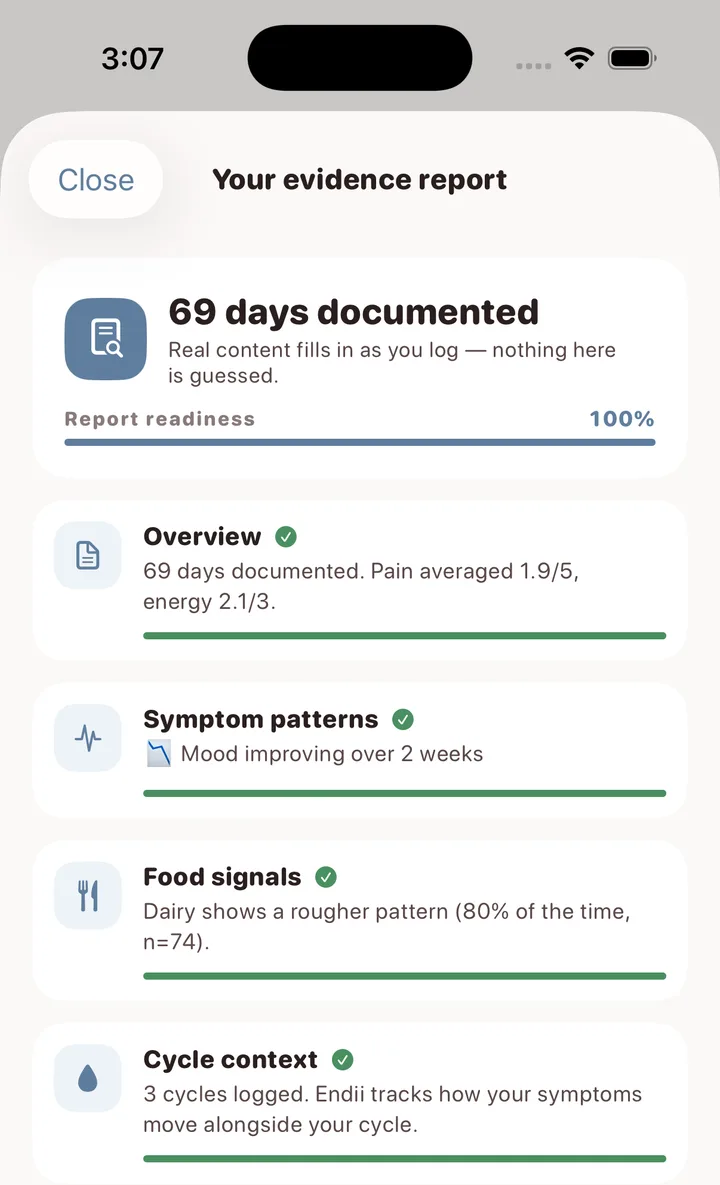
- Insights: your symptoms lined up by cycle day, so patterns are easier to spot.
- Doctor report: a clear PDF of your symptoms and patterns to take to an appointment.
Bring a clear record to your appointment.
Endii comes with a 14-day free trial.
Related guides
Sources
- Cleveland Clinic. Endometritis. my.clevelandclinic.org
- NHS. Endometriosis. nhs.uk
- Mayo Clinic. Endometriosis: symptoms and causes. mayoclinic.org
- MedlinePlus, US National Library of Medicine. Endometritis. medlineplus.gov
- MSD Manual, Professional Version. Postpartum endometritis. msdmanuals.com
- Yan X, Jiao J, Wang X. Frontiers in Endocrinology, 2025. The pathogenesis, diagnosis, and treatment of chronic endometritis: a comprehensive review. pmc.ncbi.nlm.nih.gov
- Takebayashi A, Kimura F, Kishi Y, and others. PLoS One, 2014. The association between endometriosis and chronic endometritis. pubmed.ncbi.nlm.nih.gov
- Kalaitzopoulos DR, Catena U, Schwartz AK, and others. Reproductive Sciences, 2025. Chronic endometritis and endometriosis: two sides of the same coin?. pubmed.ncbi.nlm.nih.gov
Sources last checked on 21 November 2026. We link to the page each statement comes from so you can read it in full.
Endii is a tracking journal, not medical advice. It does not diagnose or treat any condition. This page is sourced, not reviewed by a clinician. Symptoms cannot tell endometritis and endometriosis apart; only a doctor and the right tests can. A fever or new pain after a birth, a miscarriage or a procedure on the womb needs a doctor promptly. In an emergency, contact emergency services.