Quick answer
Does birth control help endometriosis? It can ease the symptoms for many people while they take it. The NHS says hormones such as the combined contraceptive pill can help ease pain, and ACOG says hormonal medications help manage pain but typically do not get rid of endometriosis tissue that is already there. It is not a cure, and pain often returns after stopping.
Hormonal birth control is one of the first treatments doctors offer for endometriosis pain. The main health bodies say it can ease symptoms while you take it, but it does not cure endometriosis or remove tissue that is already there, and pain often returns after stopping.
What can birth control do for endometriosis?
Starting or changing birth control?
Endii logs your pain, bleeding and cycle day so you and your doctor can see whether it is helping.
The short answer
The NHS1 says medicines are often the first treatment for endometriosis, and that hormones such as the combined contraceptive pill can help ease pain. It also says there are currently no treatments that can cure it.
The US Office on Women's Health2 says that if you are not trying to get pregnant, hormonal birth control is generally the first step in treatment. ACOG3, the US body for obstetricians and gynecologists, says hormonal medications can help manage pain symptoms, but typically do not get rid of endometriosis tissue that is already there.
So birth control sits in the "manage it" group, not the "fix it" group. Whether to use it, and which kind, is a decision for you and your doctor. This page reports what the sources say. It is not advice to start, stop or change anything.
How it is thought to help
Endometriosis UK4 explains the idea this way: endometriosis responds and grows when exposed to the hormone oestrogen, so hormone treatments attempt to block or reduce the oestrogen the body makes. It says the treatments aim to relieve symptoms and to prevent endometriosis from growing.
ACOG lists three things combined methods can do: control the menstrual cycle, reduce inflammation in areas of endometriosis, and keep periods regular, which can relieve pain.
The Mayo Clinic5 says many people have lighter and shorter periods on hormonal birth control, and that it may ease or get rid of pain in some cases.
The kinds health bodies describe
ACOG sorts hormonal birth control into two families.
- Combined methods. These contain estrogen and progestin. ACOG says they come as pills, a skin patch or a vaginal ring.
- Progestin-only methods. ACOG says these come as pills, a shot, an implant or the hormonal intrauterine device (IUD), and can be used to manage endometriosis lesions.
What kinds are there?
ACOG says either family can be used to reduce the number of periods you have, or to stop them altogether. The Office on Women's Health describes this as extended-cycle birth control, with only a few periods a year, or continuous-cycle, with none. The Mayo Clinic says the chances of relief seem to go up when birth control pills are used for a year or more with no breaks.
On the hormonal IUD, the Office on Women's Health adds a caution: it protects against pregnancy for up to 7 years, but may not help pain and bleeding due to endometriosis for that long.
Is there a best one
None of the health bodies we read names one.
The ESHRE guideline6, written by European specialists in 2022, recommends combined hormonal contraceptives and progestogens alike as options to reduce endometriosis pain. Its advice on choosing between them is that clinicians take a shared decision-making approach, weighing individual preferences, side effects, individual efficacy, costs and availability.
The Endometriosis Foundation of America7 asked the same question in 2018 and reported that there had not been any absolute findings, though some women appeared to do better on pills with more progestin.
The NHS says your doctor will talk to you about the risks and possible side effects of each treatment. Endometriosis UK notes that different progestogens may have different side effects. That is the conversation where a record of your own symptoms earns its place.
What it does not do
The sources are consistent on the limits.
- It does not cure endometriosis. The NHS says no current treatment can.
- It does not remove what is there. ACOG says hormonal medications typically do not get rid of endometriosis tissue that is already there.
- It works only while you take it. The Office on Women's Health says these medicines work only as long as you take them, and once you stop, your pain may come back. The Cleveland Clinic8 says the same: symptoms can come back if you stop.
- It does not help fertility. Endometriosis UK says these drugs have no effect on adhesions and do not help to improve fertility. The ESHRE guideline says clinicians should not prescribe ovarian suppression to improve fertility.
- It is not used when trying to conceive. The NHS says you will not be given hormones if you are trying to get pregnant.
The Office on Women's Health also says hormonal treatment is best for women who do not have severe pain or symptoms.
Does it work for everyone
No, and the research says so plainly.
A 2017 review in Fertility and Sterility9 gathered 58 studies of medicines for endometriosis pain. It covered hormone medicines in general, not only birth control. Across the studies, 11 to 19 in 100 women had no reduction in pain. At the end of treatment, 5 to 59 in 100 still had pain. After stopping, 17 to 34 in 100 had pain return.
Does it work for everyone?
The authors concluded that many women gain only limited or intermittent benefit from treatment. They also pointed out that few studies report the outcomes that matter to patients.
None of this predicts how you will respond. It does mean that if a method is not helping, you are not unusual, and it is worth telling your doctor.
Is your method helping? Log pain and bleeding in Endii and see it by cycle day. Free for 14 days, then a subscription.
Get EndiiThe specialists who question the pill
The official position is not the only voice. Some researchers and surgeons argue that the combined pill in particular is offered too readily, and their case is in print.
- 2017: "without any clinical evidence". Dr Robert Casper wrote in Fertility and Sterility10 that combined pills had been the first-line treatment for endometriosis pain for decades without any clinical evidence of efficacy. He suggested the early relief is likely an improvement in ordinary period pain. He also wrote that biologic data and limited clinical evidence support a potential adverse effect of long-term use on the progression of endometriosis, and argued that progestin-only pills may be a better first choice.
- 2018: the evidence review. A Cochrane review11 found five trials with 612 women. The pill was linked with less period pain than a placebo, but the evidence was rated low or very low quality. The authors concluded there was insufficient evidence to make a judgement on how effective the combined pill is.
- 2021: a surgeon's view. Dr Tamer Seckin, an endometriosis surgeon, wrote12 that birth control pills can relieve some symptoms temporarily, but that the combined pill is not really an effective treatment for endometriosis and does not always reduce pain. His view is that only complete removal of the lesions by excision surgery can fully relieve symptoms. This is published on his own surgery practice's website.
Why health bodies still recommend it
The ESHRE guideline came out in 2022, after all three of the points above, and its authors read the same Cochrane review. They still made a strong recommendation to offer hormone treatment, including combined hormonal contraceptives, as one of the options to reduce endometriosis pain.
- The trials point the same way. The Cochrane review rated the evidence as weak, but what there was showed less period pain on the pill than on a placebo.
- The concern about harm is not proven. Dr Casper himself described the clinical evidence for it as limited.
- It is usually well tolerated. Endometriosis UK says most people who take the pill do not suffer from side effects, and that it can be taken safely for many years.
- Surgery has limits too. ACOG says up to 8 in 10 women have pain again within 2 years of surgery.
| The questions raised | The official position | |
|---|---|---|
| Evidence | Too little to judge, said Cochrane in 2018 | Weak, but it points toward less pain |
| What it treats | Symptoms, not the tissue | Easing symptoms is the stated aim |
| Long-term use | One researcher sees possible harm | That evidence is limited, by his own account |
| First choice | Progestin-only, or surgery | Any method, chosen with your doctor |
So this is an open question, not a settled one. Nobody can say from here which side is right, or which is right for you. It is a fair thing to ask your doctor about.
After surgery
Birth control also comes up after an operation. ACOG says taking birth control pills or other hormonal medications after surgery may help keep you pain-free for longer.
The ESHRE guideline says clinicians should consider a hormonal IUD or a combined hormonal contraceptive for at least 18 to 24 months after surgery, to help prevent period pain from returning.
What is worth tracking on a new method
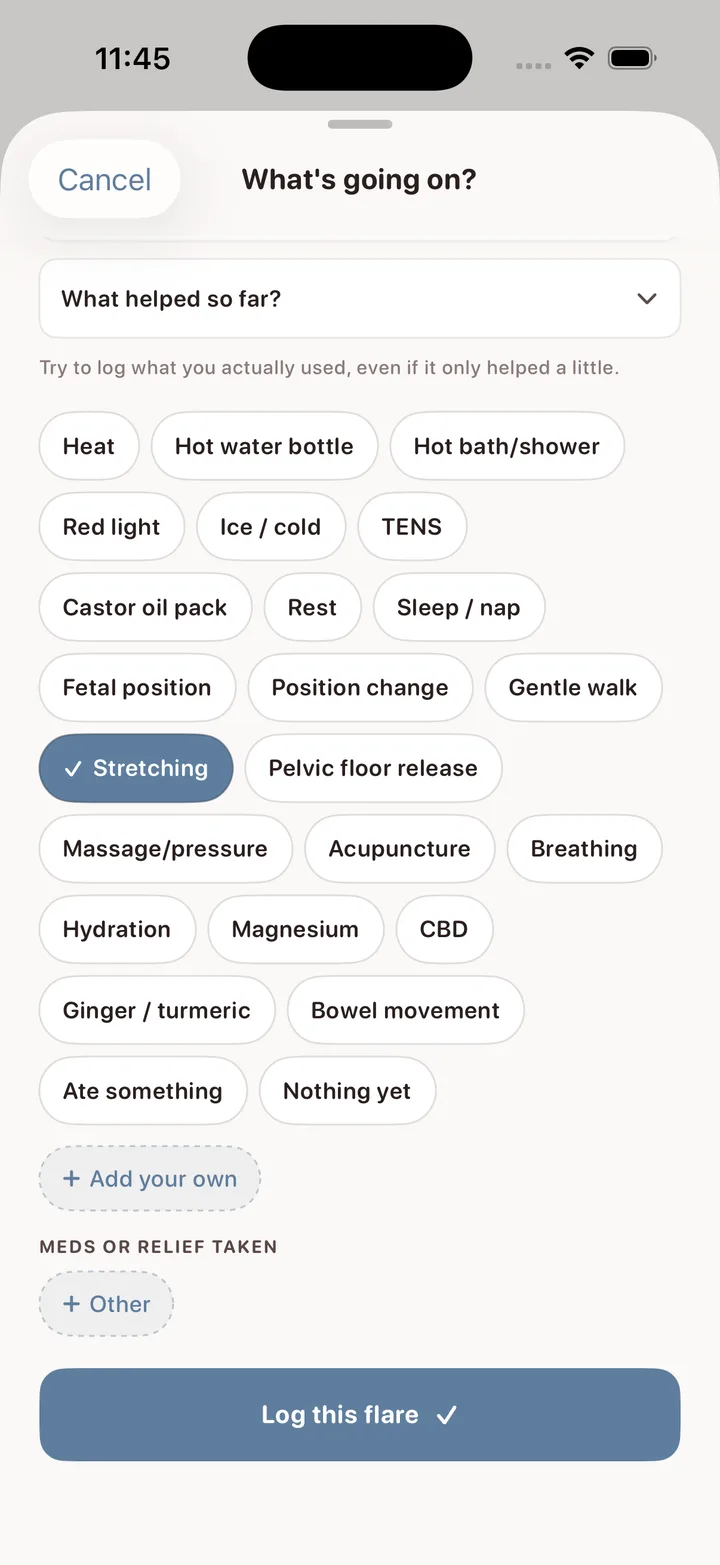
It is hard to remember how the last three months felt. A few plain notes do the job.
- The date you started or changed. So everything after it can be compared with everything before.
- Your pain each day. How strong it is and where.
- Bleeding and spotting. Including on days you did not expect any.
- Anything new since starting. Even if it seems unrelated.
- Questions as they come up.
What to jot down on a new method
Questions to bring to your doctor
Endometriosis UK suggests discussing what a treatment involves, the pros and cons, and the possible side effects. These are in that spirit.
- Which kinds are options for me, and why those?
- What side effects are worth watching for on this one?
- How long before we can tell whether it is helping?
- What happens if it does not help, or stops helping?
- What changes if I want to get pregnant later?
How Endii helps
Endii was built by a woman with endometriosis who was tired of needing three apps to manage one condition.
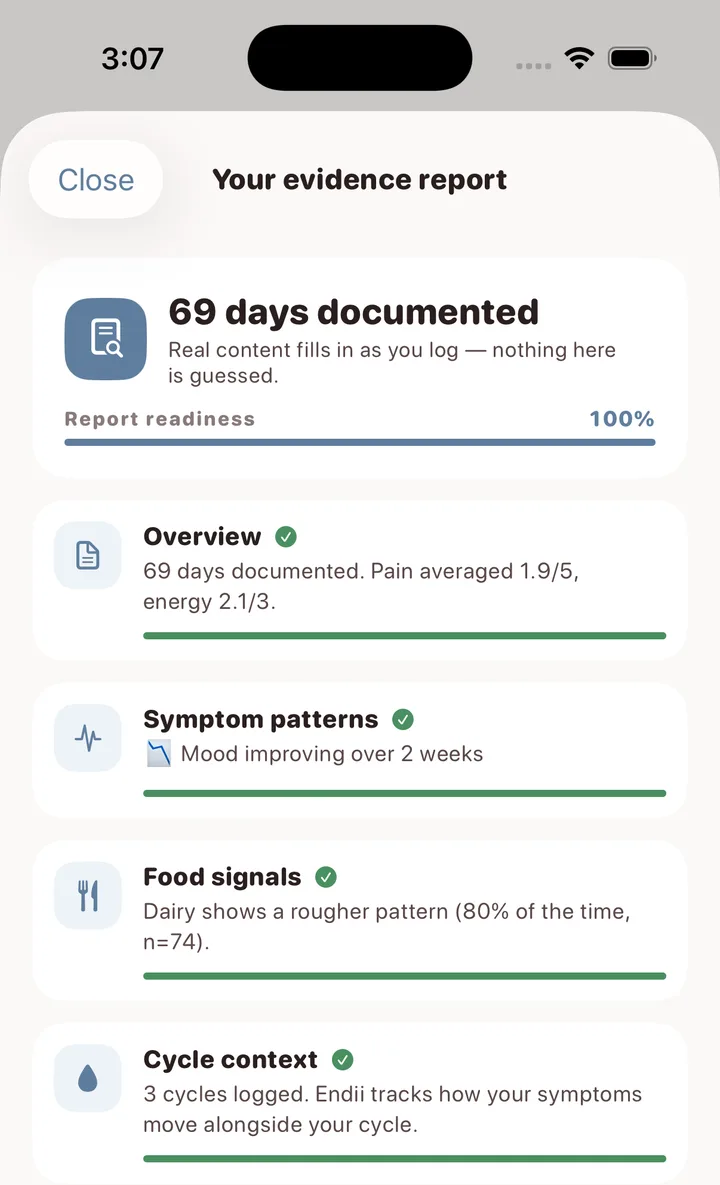
- Daily log: pain, bleeding and symptoms in a few taps, with your cycle day saved alongside.
- Patterns: see how the weeks before and after a change compare.
- Doctor report: a clear PDF of your symptoms and patterns to take to an appointment.
Show your doctor how it has really been.
Endii comes with a 14-day free trial.
Related guides
Sources
- NHS. Endometriosis. nhs.uk
- US Office on Women's Health. Endometriosis. womenshealth.gov
- American College of Obstetricians and Gynecologists (ACOG). Endometriosis: frequently asked questions. acog.org
- Endometriosis UK. Treatment and management. endometriosis-uk.org
- Mayo Clinic. Endometriosis: diagnosis and treatment. mayoclinic.org
- Becker CM, Bokor A, Heikinheimo O, and others. Human Reproduction Open, 2022. ESHRE guideline: endometriosis. pmc.ncbi.nlm.nih.gov
- Endometriosis Foundation of America (2018). All birth control pills aren't created equal in managing endometriosis, say experts. endofound.org
- Cleveland Clinic. Endometriosis. my.clevelandclinic.org
- Becker CM, Gattrell WT, Gude K, Singh SS. Fertility and Sterility, 2017. Reevaluating response and failure of medical treatment of endometriosis: a systematic review. pmc.ncbi.nlm.nih.gov
- Casper RF. Fertility and Sterility, 2017. Progestin-only pills may be a better first-line treatment for endometriosis than combined estrogen-progestin contraceptive pills. pubmed.ncbi.nlm.nih.gov
- Brown J, Crawford TJ, Datta S, Prentice A. Cochrane Database of Systematic Reviews, 2018. Oral contraceptives for pain associated with endometriosis. cochrane.org
- Tamer Seckin, MD, Seckin Endometriosis Center (2021). FAQs about birth control pills for endometriosis. drseckin.com
Sources last checked on 14 November 2026. We link to the page each statement comes from so you can read it in full.
Endii is a tracking journal, not medical advice. It does not diagnose or treat any condition. This page is sourced, not reviewed by a clinician. Do not start, stop or change any medicine because of something you read here. Always talk to a qualified doctor about your symptoms and before making medical decisions. In an emergency, contact emergency services.