Quick answer
What is excision surgery for endometriosis? It is an operation, usually keyhole surgery, in which the surgeon cuts endometriosis out of the body. Endometriosis UK describes it as using surgical equipment such as scissors, electrosurgery, ultrasound or lasers to cut out areas of endometriosis. The other main technique, ablation, uses an energy source like heat to destroy the tissue where it sits.
Excision surgery means the surgeon cuts endometriosis out of the body, usually through keyhole surgery. The other main technique, ablation, destroys the tissue where it sits. Health bodies describe both, and the trials comparing them do not give one clear winner.
Excision or ablation: what is the difference?
Surgery coming up?
Endii logs your pain, bleeding and cycle day, so you can compare the months before your operation with the months after.
The short answer
Endometriosis UK1 puts it in two lines: endometriosis is either treated by excision, meaning it is cut out, or by ablation, where an energy source like heat is used to destroy the tissue.
ACOG2, the US body for obstetricians and gynecologists, says surgery can be done to relieve pain and improve fertility, and that lesions can be removed by cutting or with a laser. It does not rank one above the other.
The NHS3 says you may be offered surgery if other treatments are not working or you have lots of endometriosis. It also says there are currently no treatments that can cure it.
Whether to have surgery, and which kind, is a decision for you and your surgeon. This page reports what the sources say. It is not advice to have an operation or to turn one down.
What excision is
Endometriosis UK describes excision surgery as using surgical equipment, like scissors, electrical or ultrasonic tools, or lasers, to cut out areas of endometriosis.
It is usually done by laparoscopy. The Cleveland Clinic4 says almost everyone who needs endometriosis surgery today can have laparoscopy, which needs only small cuts in the abdomen.
A laser can do either job. Endometriosis UK notes that lasers can be used to ablate, meaning destroy, or to excise, meaning cut out. So the tool does not tell you which technique was used. The question to ask is whether the tissue was removed or destroyed.
What ablation is
Ablation destroys endometriosis where it sits, without cutting it out. Endometriosis UK lists a laser beam that burns the tissue, and electrical heat, also called diathermy or electrocoagulation. On a surgery report it is often called fulguration, which the NCI Dictionary of Cancer Terms5 defines as using heat from an electric current to destroy tissue.
Which one is used when
It depends partly on the kind of endometriosis.
- Surface patches. Endometriosis UK says superficial endometriosis may be excised or ablated, depending on individual circumstances and the techniques available at your hospital.
- A cyst on an ovary. The ESHRE guideline6, written by European specialists in 2022, says surgeons should remove the cyst rather than drain it, because removal reduces the chance of the cyst and the pain returning.
- Deep endometriosis. Endometriosis UK says deep endometriosis is treated by excision, though in some cases this is not possible, such as when excision would be a risk to organs or blood vessels. The ESHRE guideline recommends that women with deep endometriosis are referred to a centre of expertise.
Does it depend on the kind of endometriosis?
What the trials found
Only a handful of trials have put women into an excision group or an ablation group at random and compared their pain afterwards. They are small.
- 2010, one year on. A double-blind trial in Melbourne7 found no significant difference in overall pain between the two groups at 12 months.
- 2014, five years on. The same trial8 reported that pain scores fell in both groups over five years. Deep pain during sex fell more in the excision group, and more women in the ablation group were still on medical treatment for endometriosis.
- 2017, a review. A review of three trials9 with 335 women found a greater improvement in period pain and pain with bowel movements after excision. It called the evidence limited. In 2024 the journal published an expression of concern about this review, which is noted on its PubMed record.
- 2021, a review of mild endometriosis. A review of four trials10 with 346 women found no significant difference between excision and ablation for pain from minimal to mild endometriosis. The authors said larger trials with longer follow-up are needed.
Which one works better?
None of this predicts how one person will do. The largest review looked only at minimal to mild endometriosis. It does not speak to deep endometriosis, which Endometriosis UK says is treated by excision.
Comparing before and after? Log pain and bleeding in Endii and see it by cycle day. Free for 14 days, then a subscription.
Get EndiiWhy many specialists call excision the gold standard
The guidelines are cautious. Many endometriosis surgeons and patient groups are not, and their case is in print.
- A patient foundation. An article published by the Endometriosis Foundation of America11 describes excision as the gold standard treatment for endometriosis. It says excision allows for complete removal of lesions, delaying or in some cases preventing recurrence. It describes ablation as burning off the lesion and leaving the root.
- A specialist surgery practice. The Center for Endometriosis Care12, a practice that specializes in excision, also calls it the gold standard, especially for deep endometriosis. It says ablation and other surface methods char the surface of the tissue, which makes it impossible to examine under a microscope and often leaves endometriosis behind.
- A 2025 patient survey. Researchers at an endometriosis centre13 surveyed 232 people, recruited through an endometriosis social media site, who had had both operations. They reported improvements of 28% to 46% across symptoms after excision. After ablation they reported improvement only in period pain and heavy bleeding, of about 11% and 9%.
That survey is not a trial. It was an online questionnaire about past operations, nobody was assigned to a group at random, and the authors note that people were in a worse state before their excision than before their ablation.
Why the guidelines stop short of that
The ESHRE guideline group read the same trials. Its wording is that when surgery is performed, clinicians may consider excision instead of ablation to reduce pain. It grades that as a weak recommendation, based on low quality evidence.
- The trials are small and split. Two of the four results above found no clear difference.
- The clearest gap is narrow. The five-year trial found excision ahead for deep pain during sex, not for every kind of pain.
- Surgery of either kind has limits. ACOG says up to 8 in 10 women have pain again within 2 years of surgery. The Cleveland Clinic says 20 in 100 people who have surgery will not respond and will need further medical treatment.
- Excision is not always possible. Endometriosis UK says it can be a risk to organs or blood vessels in some cases.
| Those who favour excision | The guideline position | |
|---|---|---|
| The claim | Excision is the gold standard | Excision may be considered instead of ablation |
| On ablation | It leaves endometriosis behind | No clear difference shown for mild endometriosis |
| The evidence | Surgeons' experience and a patient survey | A few small trials that do not agree |
| Deep endometriosis | Excision | Excision, at a centre of expertise |
So the two sides agree about deep endometriosis and differ about the rest. Nobody can say from here which side is right, or which is right for you. It is a fair thing to ask your surgeon about.
Does it come back
It can, after either technique. Our page on whether endometriosis can come back after surgery covers this in full.
The Cleveland Clinic says three things decide it: how severe the endometriosis was at the time of surgery, how completely the surgery removed the lesions, and whether you had hormone treatment afterwards.
The Center for Endometriosis Care, which specializes in excision, says around 20 in 100 of its own patients go on to have another surgery with findings of recurrent or persistent endometriosis.
ACOG says taking birth control pills or other hormonal medications after surgery may help keep you pain-free for longer.
Recovery and risks
Endometriosis UK says you should start to feel better within two weeks, but it may take up to 8 weeks to feel the full benefit from the surgery. The Cleveland Clinic says you should be able to return to normal routines in about two weeks, and that people with advanced endometriosis may need six weeks or longer.
The Cleveland Clinic lists the possible complications of endometriosis surgery as infection, bleeding, injury to nearby organs such as the bladder and bowel, a fistula, and blood vessel damage. The NHS adds that surgery can cause scarring that makes organs stick together.
For a fuller picture of the weeks afterwards, see endometriosis surgery recovery, week by week.
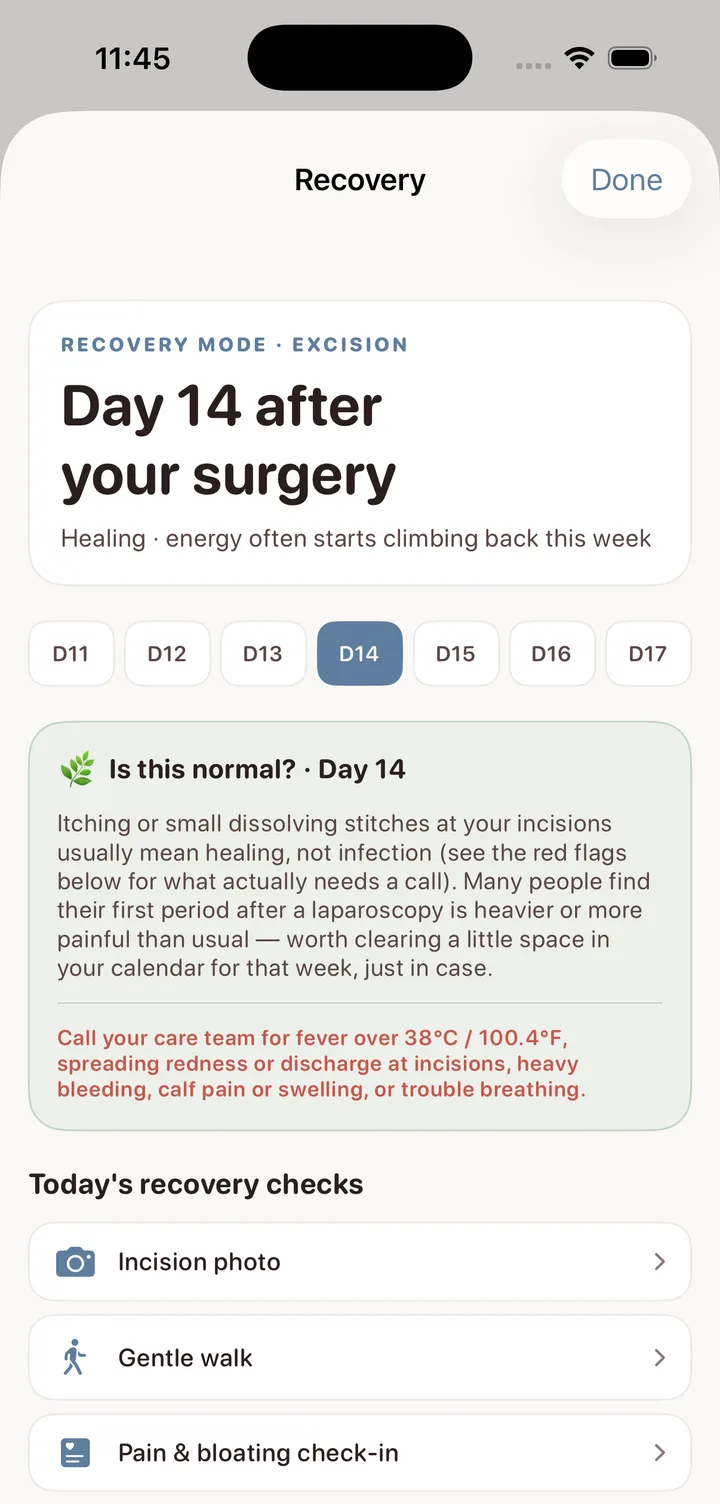
What is worth tracking before and after
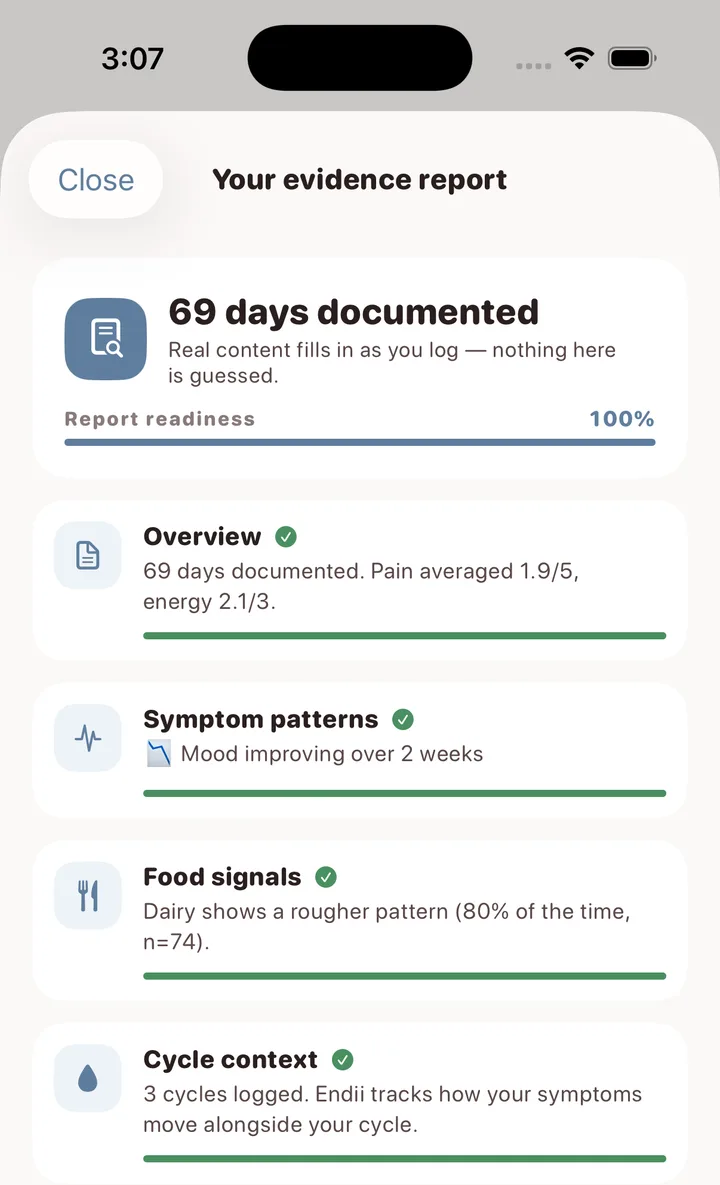
The trials measured each kind of pain on its own: period pain, pain during sex, pain with bowel movements. Notes kept the same way give you and your surgeon something to compare.
What to jot down before surgery, and after
Questions to bring to your surgeon
These come from the Endometriosis UK factsheet.
- What is the aim of my surgery?
- What surgical method will you use to remove endometriosis, and why?
- Will the pain return after surgery?
- Will my endometriosis come back after surgery?
- Will this surgery improve my chances of getting pregnant?
ACOG says you may be able to choose a surgeon who specializes in endometriosis. The Mayo Clinic14 says you may want to get a second opinion before you start any treatment, so you know all of your options and the pros and cons of each.
How Endii helps
Endii was built by a woman with endometriosis who was tired of needing three apps to manage one condition.
- Daily log: pain, bleeding and symptoms in a few taps, with your cycle day saved alongside.
- Recovery mode: a day by day view of the weeks after an operation.
- Doctor report: a clear PDF of your symptoms and patterns to take to an appointment.
Show your surgeon how it has really been.
Endii comes with a 14-day free trial.
Related guides
Sources
- Endometriosis UK. Surgery for endometriosis: factsheet (reviewed January 2026). endometriosis-uk.org
- American College of Obstetricians and Gynecologists (ACOG). Endometriosis: frequently asked questions. acog.org
- NHS. Endometriosis. nhs.uk
- Cleveland Clinic. Endometriosis surgery. my.clevelandclinic.org
- National Cancer Institute. NCI Dictionary of Cancer Terms: fulguration. cancer.gov
- Becker CM, Bokor A, Heikinheimo O, and others. Human Reproduction Open, 2022. ESHRE guideline: endometriosis. pmc.ncbi.nlm.nih.gov
- Healey M, Ang WC, Cheng C. Fertility and Sterility, 2010. Surgical treatment of endometriosis: a prospective randomized double-blinded trial comparing excision and ablation. pubmed.ncbi.nlm.nih.gov
- Healey M, Cheng C, Kaur H. Journal of Minimally Invasive Gynecology, 2014. To excise or ablate endometriosis? A prospective randomized double-blinded trial after 5-year follow-up. pubmed.ncbi.nlm.nih.gov
- Pundir J, Omanwa K, Kovoor E, and others. Journal of Minimally Invasive Gynecology, 2017. Laparoscopic excision versus ablation for endometriosis-associated pain: an updated systematic review and meta-analysis. pubmed.ncbi.nlm.nih.gov
- Burks C, Lee M, DeSarno M, Findley J, Flyckt R. Journal of Minimally Invasive Gynecology, 2021. Excision versus ablation for management of minimal to mild endometriosis: a systematic review and meta-analysis. pubmed.ncbi.nlm.nih.gov
- Endometriosis Foundation of America (2022). Scheduling excision surgery? Considerations to keep in mind. endofound.org
- The Center for Endometriosis Care. About excision (LAPEX). centerforendo.com
- Isaac A, Kapetanakis T, Thibeault E, Chatburn L, Mackenzie M. Journal of Minimally Invasive Gynecology, 2025. Patient perception and experience of laparoscopic excision versus ablation of endometriosis: a crowd-sourced comparative evaluation. pubmed.ncbi.nlm.nih.gov
- Mayo Clinic. Endometriosis: diagnosis and treatment. mayoclinic.org
Sources last checked on 15 November 2026. We link to the page each statement comes from so you can read it in full.
Endii is a tracking journal, not medical advice. It does not diagnose or treat any condition. This page is sourced, not reviewed by a clinician. Do not decide for or against an operation because of something you read here. Always talk to a qualified doctor about your symptoms and before making medical decisions. In an emergency, contact emergency services.