Quick answer
How long does it take to recover from endometriosis surgery? It depends on the type and extent of the surgery. The Cleveland Clinic says most people are back to normal routines about two weeks after laparoscopic endometriosis surgery, and that surgery for advanced endometriosis can take six weeks or longer. The NHS says full recovery after laparoscopic surgery can take up to 6 to 8 weeks. Your surgeon will give you a timeline for your own operation.
The question everyone asks before endometriosis surgery is the same: how long until I feel normal again?
The answer depends on what your surgeon does once they are in there. A short diagnostic laparoscopy and a long excision surgery are very different operations with very different recoveries. Your surgeon's instructions always come first. What follows is what people commonly describe, so the days ahead feel less unknown.
Preparing for surgery?
Endii has a pre-op checklist and a day by day recovery mode.
How long recovery takes
The Cleveland Clinic1 says most people are back to their normal routines about two weeks after laparoscopic endometriosis surgery, and that surgery for advanced endometriosis can take six weeks or longer. The NHS2 says a diagnostic laparoscopy can take up to 10 days to recover from, and that after laparoscopic surgery full recovery can take up to 6 to 8 weeks.
Those are ranges, not promises. Yours depends on what was done.
Two things are worth knowing. The small incisions on the outside heal faster than the work done on the inside, so feeling fine on the surface does not mean you are finished healing. And recovery is rarely a straight line. A good day followed by a rough one is common.
Ask your surgeon for their timeline for your operation, including when you can drive, lift, exercise, have sex and go back to work.
Recovery times the main sources give, in weeks
Before surgery: get ready
The weeks before are easier if you sort out three things.
- Questions for your surgeon. What exactly are you planning to do? Will you remove what you find or only look? How long should I plan to be off work? Who do I call if something worries me afterwards?
- Your hospital bag. Loose, high-waisted clothes that do not press on your belly, slip-on shoes, a pillow for the car ride home, a long phone charger.
- Time off and help at home. Arrange more than you think you need. It is easier to go back early than to ask for more.
Days 1 to 3
People commonly describe feeling groggy from the anaesthetic, sore around the incisions, bloated and very tired. Shoulder pain is also common after a laparoscopy. Both the NHS2 and the Royal College of Obstetricians and Gynaecologists3 list it as a usual after-effect.
Rest, short gentle walks if your team has said to, and whatever pain relief you were prescribed.
Days 4 to 7
Energy dips are common this week. Some days feel like real progress and others feel like a slide backwards. Both are part of an ordinary recovery.
Week 2
Many people start to feel more like themselves. The Royal College of Obstetricians and Gynaecologists says most women feel able to return to work one to three weeks after a laparoscopy, sooner after a simple procedure and later after a bigger one. Tiredness can linger after everything else has improved.
Recovering from surgery? Note each day's pain, bleeding and energy in Endii, so you can show your surgeon how recovery is going. Free for 14 days, then a subscription.
Get EndiiWeeks 3 to 6
Activity usually builds back gradually. Some people say their first period after surgery feels different from usual. If you have heavy or unusual bleeding, get medical advice instead of waiting for your follow-up.
Your follow-up appointment is the time to ask what was found, what was removed, and what happens next. Ask for a copy of your operation notes.
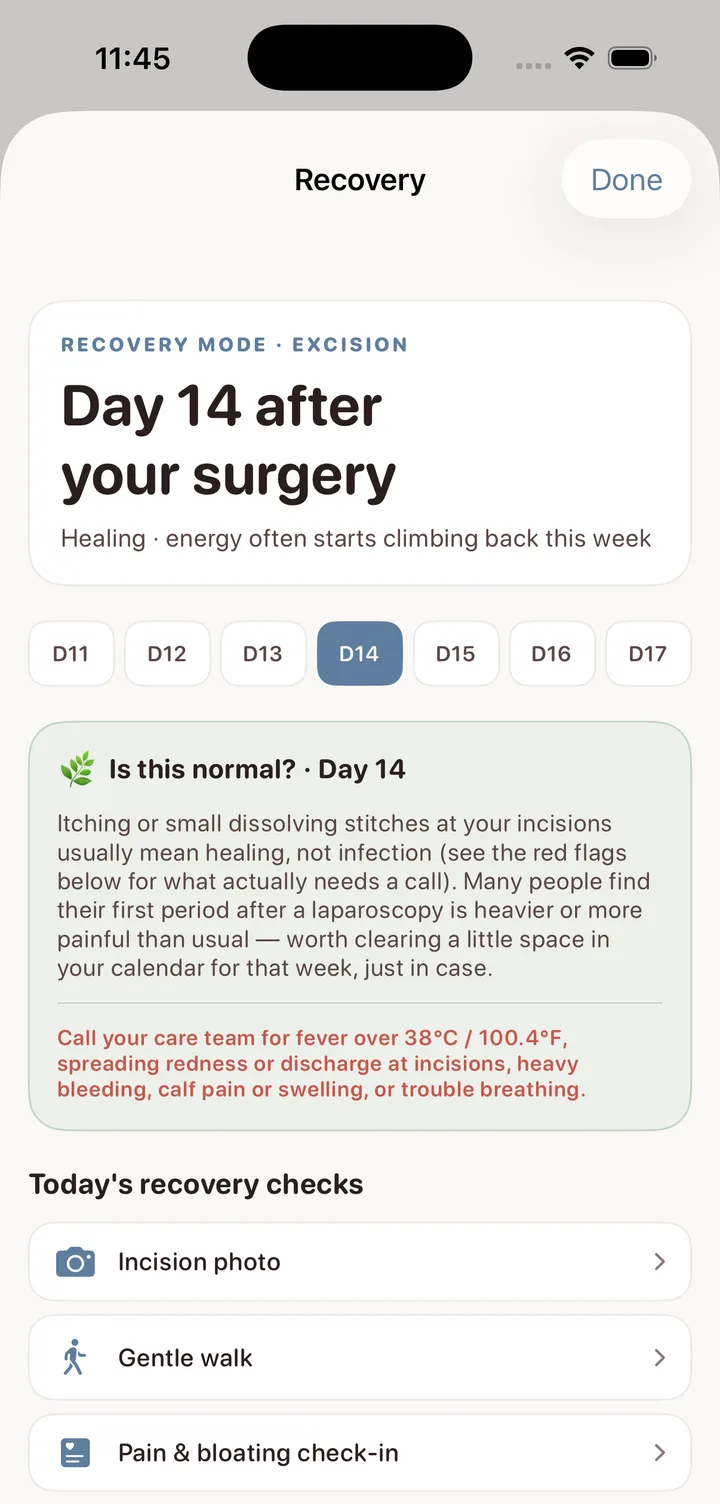
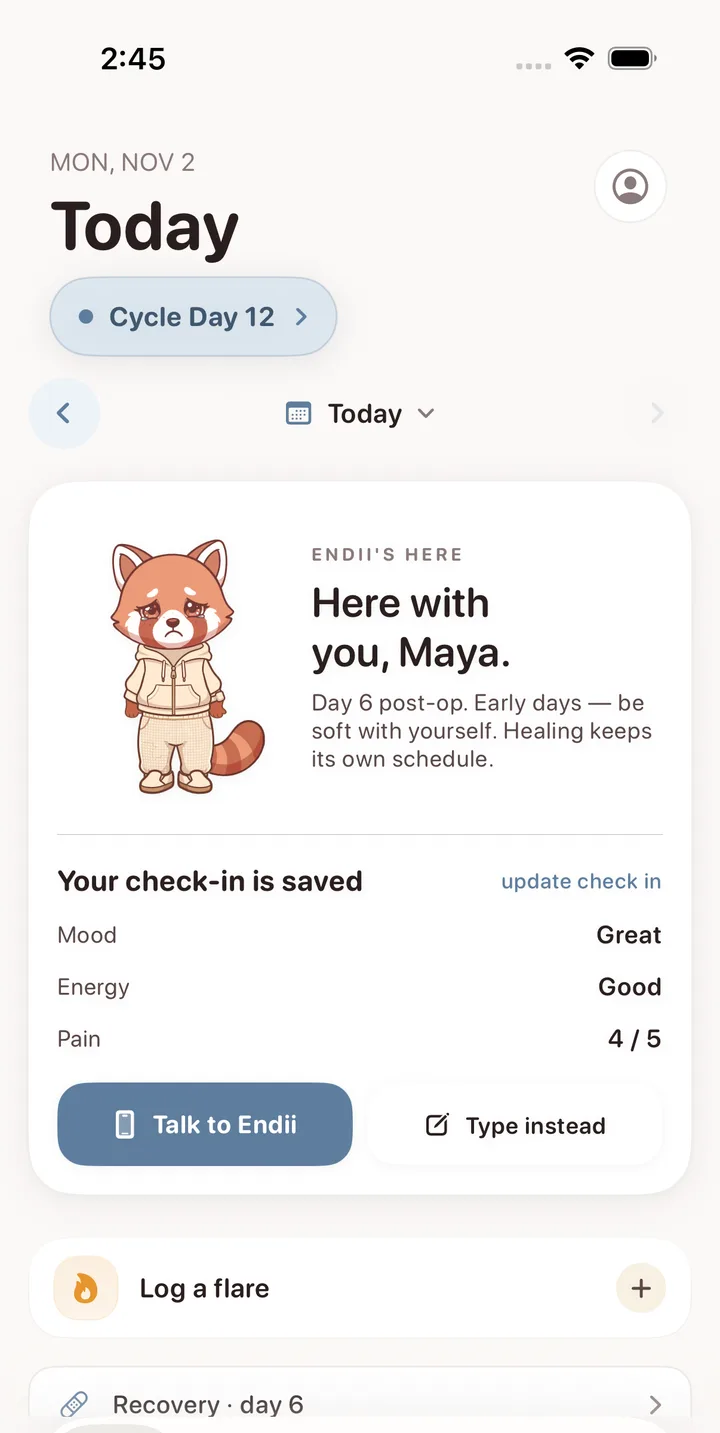
What to track while you recover
A few lines a day is enough:
- Pain level, and where
- Bloating
- Energy
- How your incisions look, with a photo if you like
- What you took, and when
- How far you walked
This makes your follow-up appointment much easier. You will have a record to hand over.
When to call your care team
The NHS2 and the Cleveland Clinic1 say to get medical advice for any of these:
- A high temperature, or feeling hot, cold or shivery
- Pain that is getting worse, or that your medication does not help
- Redness, swelling, bleeding or pus at a wound
- Heavy or unusual vaginal bleeding
- Pain and swelling in one leg
- Difficulty breathing
Follow the instructions your hospital gave you, and if you are unsure, call. In an emergency, contact emergency services.
How Endii helps with surgery
I built Endii because I have endometriosis and wanted everything in one place, surgery included.
- Pre-op checklist: questions for your surgeon, your hospital bag, and planning time off.
- Recovery mode: follow your recovery day by day, with gentle daily checks, what people commonly experience at that point, and the red flags for contacting your care team.
- Records: keep your operation notes and letters together on your phone.
- Doctor report: a clear PDF of your symptoms and history for your follow-up.
Having surgery soon, or just home?
Endii comes with a 14-day free trial.
Related guides
Sources
- Cleveland Clinic. Endometriosis surgery. my.clevelandclinic.org
- NHS. Laparoscopy (keyhole surgery). nhs.uk
- Royal College of Obstetricians and Gynaecologists (RCOG). Laparoscopy: recovering well. rcog.org.uk
Sources last checked on 10 November 2026. We link to the page each statement comes from so you can read it in full.
Endii is a tracking journal, not medical advice. It does not diagnose or treat any condition. Recovery varies from person to person and from surgery to surgery. Always follow your surgeon's instructions and talk to a qualified doctor before making medical decisions. In an emergency, contact emergency services.