Quick answer
Can you see endometriosis on an ultrasound? Sometimes. An ultrasound can find the ovarian cysts called endometriomas, and deep endometriosis in the bowel or bladder can often be seen. Most endometriosis is superficial and usually does not show on a scan, so a normal ultrasound does not rule it out.
One of the hardest moments with endometriosis is being told your scan is clear when your body is telling you something else.
A clear scan is good news about some things. It is not an answer about endometriosis. Here is what each test can and cannot show.
Keep every scan report and your symptom record in one place.
The short version
| Test | What it can show | What it can miss |
|---|---|---|
| Ultrasound | Cysts on the ovaries (endometriomas). Deep endometriosis in the bowel or bladder can often be seen | Superficial endometriosis, small areas and adhesions |
| MRI | Deep or extensive endometriosis, including bowel and bladder. Used to plan surgery | Superficial endometriosis |
| CT scan | Rarely used for endometriosis. Mentioned only for suspected deep bowel disease | Most endometriosis |
| Pap smear | The health of the cervix | Endometriosis. It is not a test for it |
Ultrasound
The Mayo Clinic1 says a standard ultrasound will not confirm endometriosis, but can find the ovarian cysts called endometriomas. ACOG2 calls transvaginal ultrasound the best imaging test for finding endometriosis.
The Mayo Clinic also explains the catch. Most endometriosis is superficial and usually does not show on imaging, while deep endometriosis growing into the bowel or bladder can often be seen on ultrasound or MRI.
MRI
ACOG says an MRI may be needed for endometriosis that is deeper, or outside the pelvis. The Royal College of Obstetricians and Gynaecologists3 describes MRI as useful for deep or extensive disease involving the bowel or bladder, and for planning surgery.
CT scan
Most of the main sources do not mention CT for endometriosis at all. Endometriosis UK4 mentions CT or MRI only when deep bowel disease is suspected.
Pap smear
No source we read says a Pap smear can detect endometriosis. The NHS5 describes cervical screening as a check on the health of the cervix, to help prevent cervical cancer.
Clear scan, still in pain? Keep a dated record of your symptoms in Endii to bring to your next appointment. Free for 14 days, then a subscription.
Get EndiiA normal scan does not rule it out
The Royal College of Obstetricians and Gynaecologists says a normal result from an ultrasound or MRI scan does not rule out endometriosis. ACOG and Endometriosis UK say the same. The US National Institute of Child Health and Human Development6 says imaging can locate larger areas such as nodules or cysts, but does not help diagnose small lesions or adhesions.
So how is it confirmed
Sources differ here, and the guidance is changing.
Several, including ACOG and the US Office on Women's Health, say surgery, usually a laparoscopy, is the only way to be certain. ACOG adds that surgery is not required before starting treatment.
The European guideline group ESHRE7 now recommends ultrasound or MRI as part of the work-up, and no longer treats laparoscopy as the gold standard. It suggests laparoscopy when imaging is negative or when treatment has not helped.
Either way, your symptoms are part of the evidence. A scan is one piece.
What to bring to a scan appointment
- Where your pain is, and when in your cycle it is worst
- Bowel and bladder symptoms, and whether they follow your period
- Earlier scan reports and operation notes
- Treatments you have tried, with dates
- The question: "If this scan is normal, what happens next?"
How Endii helps
Endii was built by a woman with endometriosis who was tired of needing three apps to manage one condition.
- Records: store MRIs, scan results, letters and operation notes. Scan documents with your camera or import PDFs.
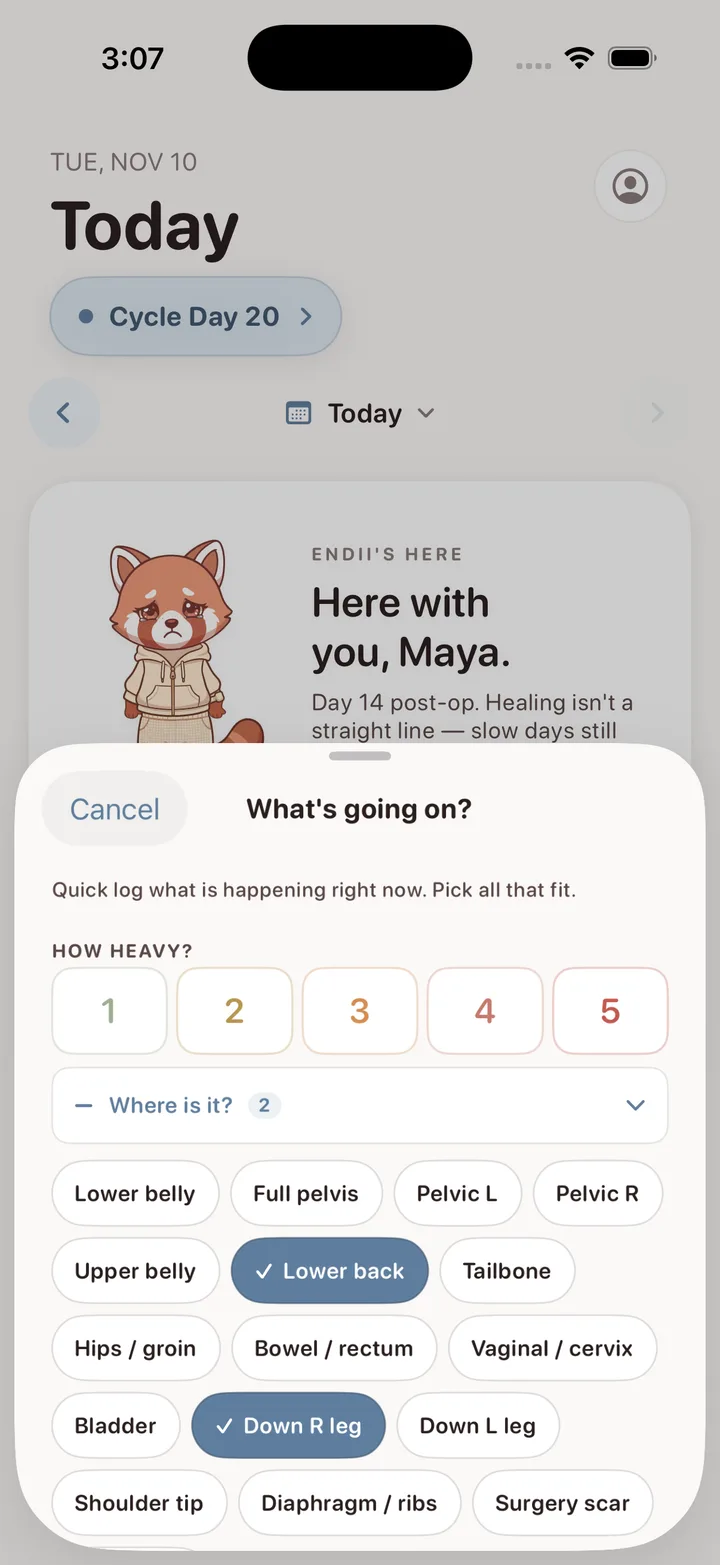
- Pain by location, alongside your cycle day.
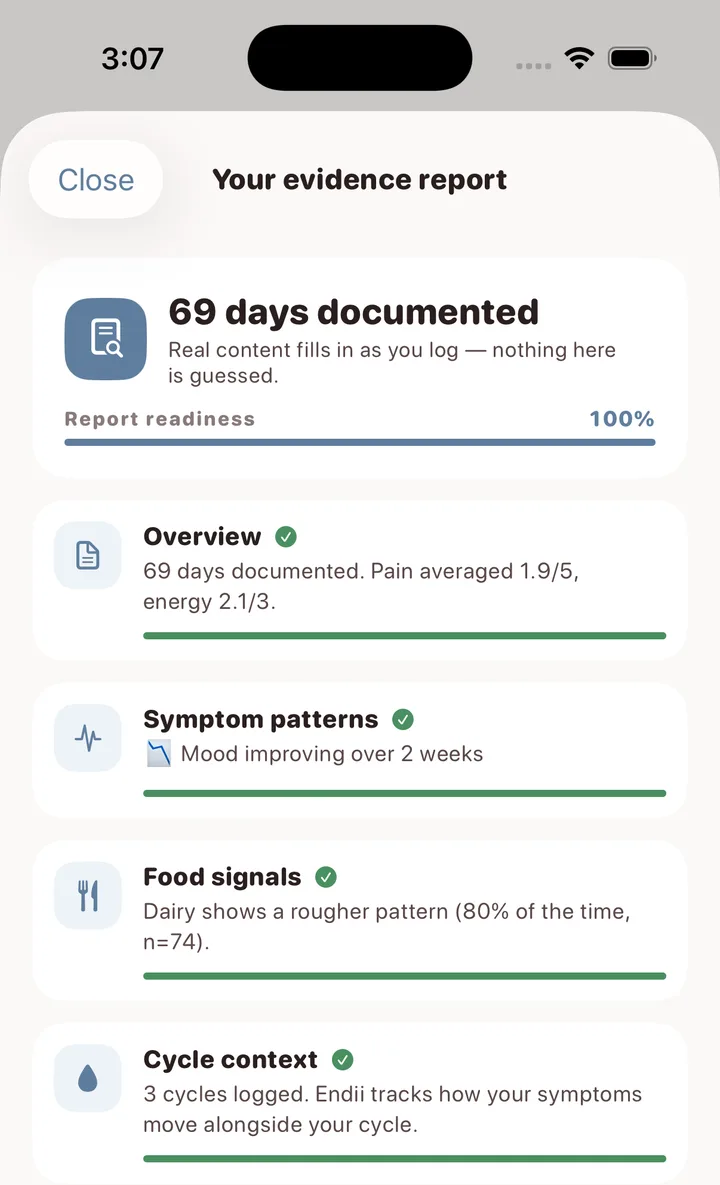
- Doctor report: a clear PDF of symptoms, patterns and treatments tried.
A clear scan is not the end of the conversation. Bring your record.
Endii comes with a 14-day free trial.
Related guides
Sources
- Mayo Clinic. Endometriosis: diagnosis and treatment. mayoclinic.org
- American College of Obstetricians and Gynecologists (ACOG). Endometriosis: frequently asked questions. acog.org
- Royal College of Obstetricians and Gynaecologists (RCOG). Endometriosis: patient information. rcog.org.uk
- Endometriosis UK. Endometriosis and the bowel. endometriosis-uk.org
- NHS. Cervical screening. nhs.uk
- US National Institute of Child Health and Human Development (NICHD). How do healthcare providers diagnose endometriosis?. nichd.nih.gov
- Becker CM, Bokor A, Heikinheimo O, and others. Human Reproduction Open, 2022. ESHRE guideline: endometriosis. pmc.ncbi.nlm.nih.gov
Sources last checked on 10 November 2026. We link to the page each statement comes from so you can read it in full.
Endii is a tracking journal, not medical advice. It does not diagnose or treat any condition. Always talk to a qualified doctor about your symptoms and before making medical decisions. In an emergency, contact emergency services.