Quick answer
Is endometriosis hereditary? Partly. ACOG says endometriosis may be partly inherited, passed from parent to child through genes, and that a close relative with it makes you more likely to have it too. Twin studies from Australia and Sweden put about half of the risk down to genes, and the rest to other things.
Yes, partly. Endometriosis can run in families: twin studies put about half of the risk down to genes and about half to other things, so a relative with it raises your chances without deciding them.
How much of it is in your genes?
Family history and your own symptoms?
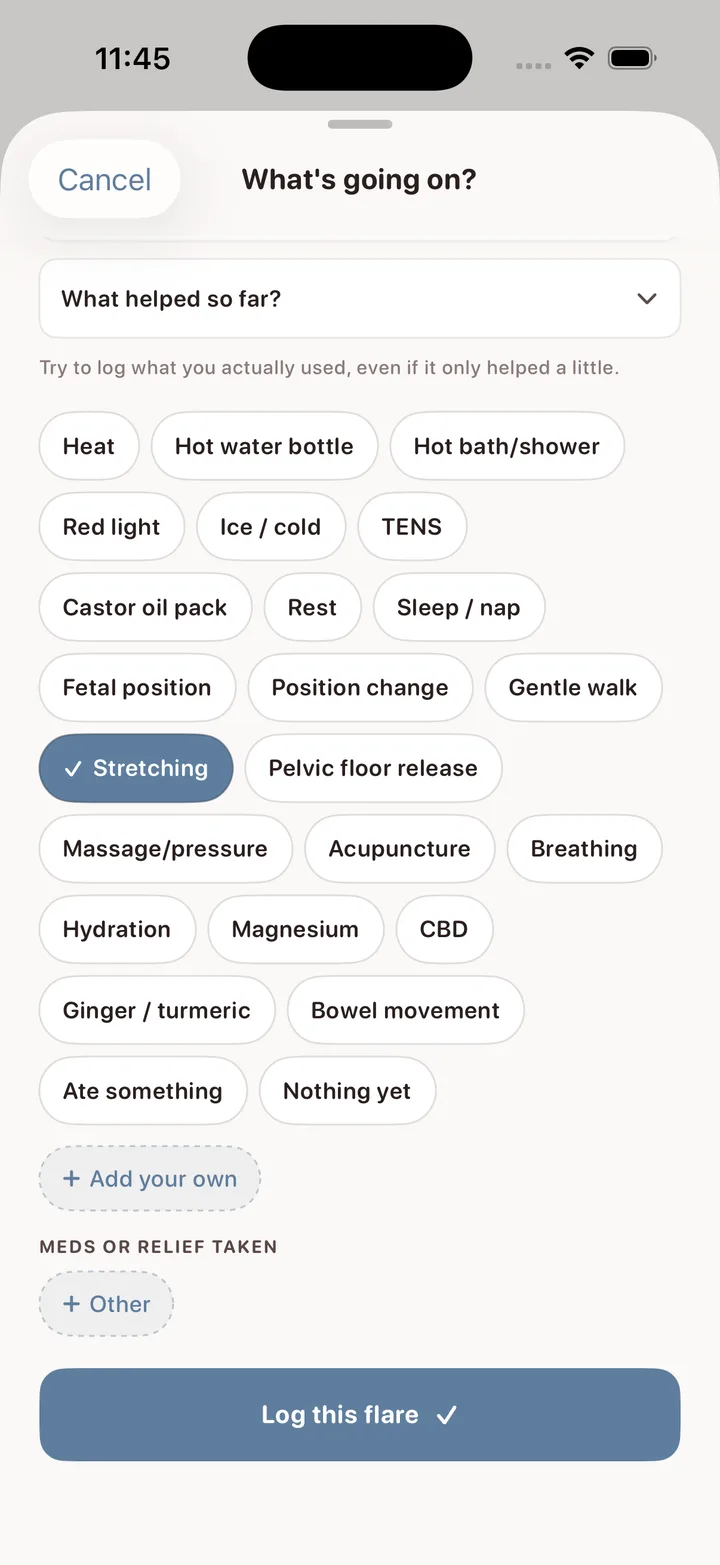
Endii keeps a daily log of pain, bleeding and cycle day that you can hand to your doctor.
The short answer
The main health bodies agree that family history matters. ACOG1, the US body for obstetricians and gynecologists, says endometriosis may be partly inherited, passed down from parent to child through genes, and that if you have a close relative with it, you are more likely to have it too.
The Mayo Clinic2 lists one or more relatives with endometriosis, such as a mother, aunt or sister, among its risk factors. The Cleveland Clinic3 lists a biological family history as one too.
But none of these bodies says genes alone cause it. The NHS4 says it is not known what causes endometriosis. A risk factor raises the chance; it does not decide it.
How researchers know it runs in families
If one twin has it, does the other?
The clearest evidence comes from twins. Identical twins share all their genes, and non-identical twins share about half. If a condition is partly genetic, identical twins should share it more often.
- Australia, 1999. A study of 3,096 twins5 found that identical twins were more alike for endometriosis than non-identical twins. The authors estimated that about 51 percent of the risk may come from genes.
- Sweden, 2015. A study of 28,370 female twins6, with the diagnosis checked against medical records, found that when one identical twin had endometriosis, the other had it in about 21 of 100 pairs. For non-identical twins it was about 10 of 100. The authors put 47 percent of the risk down to genes and 53 percent to things the twins did not share.
- Iceland, 2002. A study of 750 women7 used the country's large family-tree records. Sisters of women with endometriosis were about five times as likely to have it, and cousins about one and a half times as likely.
So the studies point the same way: genes matter, and they explain about half of the picture.
Who in your family counts
Who in your family counts?
The closer the relative, the larger the raised risk in the Iceland study: sisters more than cousins. The health bodies name a mother, aunt, grandmother or sister.
Your father's side counts too. The same Iceland study found that cousins who both had endometriosis were as likely to be connected through their fathers as through their mothers. Your father does not need to have endometriosis himself to pass on genes linked to it.
A raised risk is still not a diagnosis. In the Swedish study, most identical twins of a woman with endometriosis did not have it, even with the same genes.
Endometriosis in your family? Start a record of your own symptoms in Endii, by cycle day. Free for 14 days, then a subscription.
Get EndiiWhat the genes actually are
There is no single endometriosis gene. A 2010 review8 said the studies suggest it is inherited in a polygenic and multifactorial way: many genes, each adding a little, together with other factors.
The largest study so far was published in 2023 in Nature Genetics9, led by the University of Oxford10 with 25 teams. It compared the DNA of 60,674 women with endometriosis and 701,926 without. It found:
- 42 areas of DNA linked to endometriosis. Together the signals explained up to 5 percent of the differences in who has it.
- Stronger links for stage 3 and 4, driven by endometriosis on the ovaries. The Oxford team said cysts on the ovaries seem to have a different genetic basis from other kinds.
- Shared genes with other pain. Endometriosis shared genetic ground with 11 pain conditions, including migraine, back pain and pain in many places at once, and with some inflammatory conditions such as asthma.
So there is a gap: about half of the risk from genes in the twin studies, and up to 5 percent explained by the genes found so far. Most of the genetic part has not been pinned down yet.
What genes do not explain
The other half of the risk is not from genes, and it is not well understood either.
- Other risk factors. ACOG lists starting periods before age 10, cycles shorter than 26 days, not having had children, being underweight and differences in the shape of the uterus.
- Before birth. In a Mayo Clinic video, Dr Megan Wasson, a gynecologic surgeon, says the current thinking is that endometriosis likely starts during development as a fetus.
- The environment. Endometriosis UK11 describes a theory that toxins such as dioxin may play a part, and says it has not been proven in humans. It also says some families may be more susceptible, but the causes of this are unclear.
Retrograde menstruation, when period blood flows back into the pelvis, is another theory the health bodies describe. None of these theories explains every case on its own.
What to tell your doctor
What to tell your doctor about your family
The NHS says a GP will ask about your symptoms and whether any close relatives have had endometriosis. It can take a long time to diagnose endometriosis, so it helps to arrive with both answers ready: the family history, and a clear record of your own symptoms.
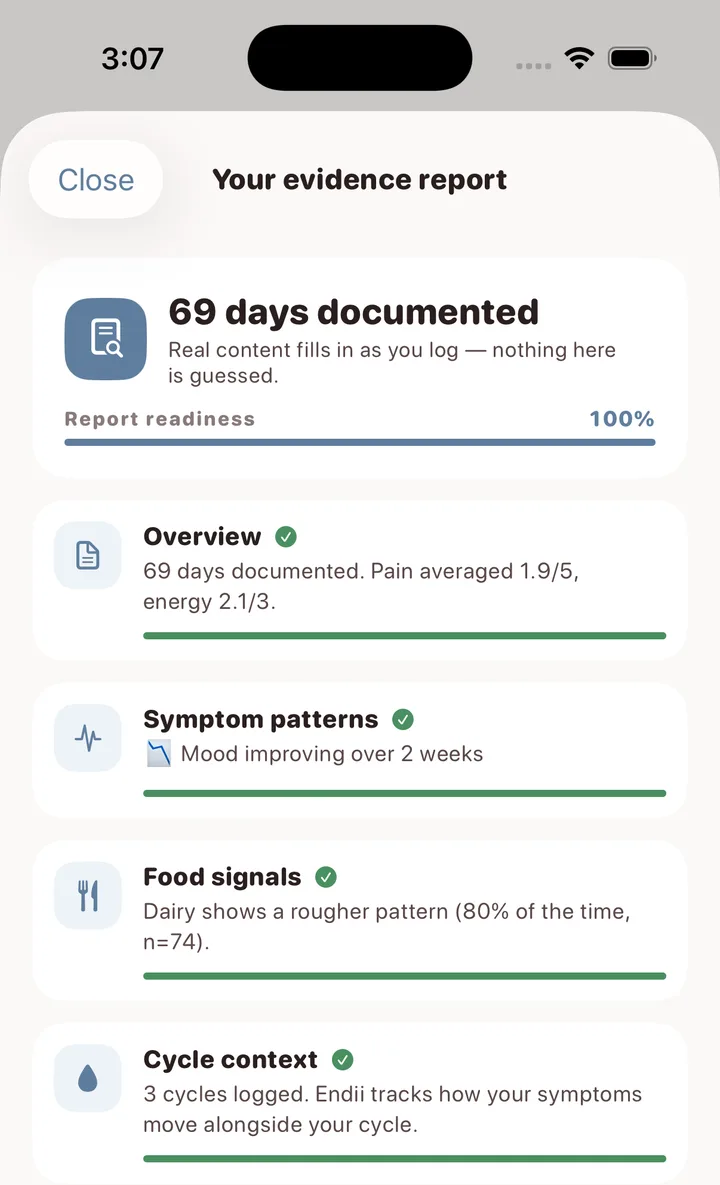
Your notes are the part a doctor cannot get any other way. Pain, bleeding and other symptoms, tied to your cycle day, show a pattern a single appointment cannot.
Questions to bring to your doctor
- My mother, sister or another relative has endometriosis. Does that change how you look at my symptoms?
- Which of my symptoms would you want me to keep track of, and for how long?
- What would the next step be if my symptoms continue?
- Is there anything in my family history, on either side, that you would want to know more about?
How Endii helps
Endii was built by a woman with endometriosis who was tired of needing three apps to manage one condition.
- Daily log: pain, bleeding and symptoms in a few taps, with your cycle day saved alongside.
- Insights: your symptoms lined up by cycle day, so patterns are easier to spot.
- Doctor report: a clear PDF of your symptoms and patterns to take to an appointment.
Bring more than a family history.
Endii comes with a 14-day free trial.
Related guides
Sources
- American College of Obstetricians and Gynecologists (ACOG). Endometriosis: frequently asked questions. acog.org
- Mayo Clinic. Endometriosis: symptoms and causes. mayoclinic.org
- Cleveland Clinic. Endometriosis. my.clevelandclinic.org
- NHS. Endometriosis. nhs.uk
- Treloar SA, O'Connor DT, O'Connor VM, Martin NG. Fertility and Sterility, 1999. Genetic influences on endometriosis in an Australian twin sample. pubmed.ncbi.nlm.nih.gov
- Saha R, Pettersson HJ, Svedberg P, and others. Fertility and Sterility, 2015. Heritability of endometriosis. pubmed.ncbi.nlm.nih.gov
- Stefansson H, Geirsson RT, Steinthorsdottir V, and others. Human Reproduction, 2002. Genetic factors contribute to the risk of developing endometriosis. pubmed.ncbi.nlm.nih.gov
- Hansen KA, Eyster KM. Clinical Obstetrics and Gynecology, 2010. Genetics and genomics of endometriosis. pubmed.ncbi.nlm.nih.gov
- Rahmioglu N, Mortlock S, Ghiasi M, and others. Nature Genetics, 2023. The genetic basis of endometriosis and comorbidity with other pain and inflammatory conditions. nature.com
- University of Oxford, 14 March 2023. Global study shows the experience of endometriosis is rooted in genetics. ox.ac.uk
- Endometriosis UK. Causes. endometriosis-uk.org
Sources last checked on 17 November 2026. We link to the page each statement comes from so you can read it in full.
Endii is a tracking journal, not medical advice. It does not diagnose or treat any condition. This page is sourced, not reviewed by a clinician. A family history raises the chance of endometriosis; it does not mean you have it, and having no family history does not rule it out. Always talk to a qualified doctor about your symptoms and before making medical decisions. In an emergency, contact emergency services.