Quick answer
Is endometriosis an autoimmune disease? No. Endometriosis is not classed as an autoimmune disease, and the NHS, the Mayo Clinic and the World Health Organization all say its cause is not known. Research does suggest the immune system is involved, and some autoimmune conditions are diagnosed more often in people with endometriosis.
No. Endometriosis is not classed as an autoimmune disease, and the NHS, the Mayo Clinic and the World Health Organization all say its cause is not known. What research does suggest is that the immune system is involved in some way, and that some autoimmune conditions are diagnosed more often in people who have endometriosis.
Is endometriosis autoimmune?
Symptoms that do not fit in one box?
Endii keeps every symptom, date and cycle day in one place, ready to show a doctor.
The short answer
The Global Autoimmune Institute1 puts it in one line: endometriosis has not been classified as an autoimmune condition, but it has been linked to an increased risk of autoimmune diseases.
None of the health bodies we read for this page describes endometriosis as autoimmune. The NHS2 says it is not known what causes it. The Mayo Clinic3 says the exact cause is not clear. The World Health Organization4 says the causes are unknown, and adds that emerging research suggests endometriosis is associated with immune system dysregulation.
So the honest answer has two halves. It is not on the autoimmune list. And the immune system keeps coming up when researchers look for what is going on.
What autoimmune means
MedlinePlus5, from the US National Library of Medicine, defines it this way: if you have an autoimmune disease, your immune system attacks the healthy cells of your organs and tissues by mistake.
It says there are more than 80 types, and they can affect almost any part of the body. Rheumatoid arthritis and type 1 diabetes are two of the examples it gives.
Endometriosis is described differently. The NHS says it is where cells similar to those in the lining of the womb grow in other parts of the body. That description is about tissue growing in the wrong place, not about the immune system attacking healthy cells.
Where the immune system comes in
Several sources list the immune system among the possible explanations for endometriosis, without saying it is the cause.
- Mayo Clinic. One possible cause it lists is an immune system condition: a problem with the immune system may make the body unable to recognize and destroy endometriosis tissue.
- US Office on Women's Health. The Office on Women's Health6 says a faulty immune system may fail to find and destroy endometrial tissue growing outside of the uterus.
- Cleveland Clinic. The Cleveland Clinic7 says researchers are looking for a connection between endometriosis and immune system conditions, among other factors.
- Endometriosis UK. Endometriosis UK8 says it is thought that in some cases the immune system is not able to fight off endometriosis.
- Endometriosis Foundation of America. The Endometriosis Foundation of America9 says endometriosis is associated with immune and hormonal disruptions, and that these mechanisms are poorly understood.
Put next to the MedlinePlus definition, these describe something different from an autoimmune disease. In an autoimmune disease the immune system attacks healthy cells. The idea in these sources is that the immune system may not be clearing away tissue that is in the wrong place.
What might the immune system be doing?
Is endometriosis an inflammatory disease
Inflammation appears in most descriptions of endometriosis. The World Health Organization says the tissue growing outside the uterus causes inflammation and scar tissue formation, and calls endometriosis a chronic disease. ACOG10 says the tissue around the lesions can become irritated, inflamed and swollen. The Endometriosis Foundation of America says that as endometriosis grows, it causes inflammation.
Inflammation and autoimmunity are not the same thing. Sources agree that inflammation is part of endometriosis. They do not say the immune system is attacking the body's own healthy tissue.
The autoimmune conditions linked with endometriosis
This is where the question usually comes from. People with endometriosis are diagnosed with some autoimmune conditions more often than people without it.
- World Health Organization. People with endometriosis have higher rates of other immune-mediated conditions, such as lupus, multiple sclerosis and inflammatory bowel disease.
- US Office on Women's Health. Research shows a link between endometriosis and autoimmune diseases, which can include multiple sclerosis, lupus and some types of hypothyroidism. It also lists allergies, asthma, chronic fatigue syndrome and fibromyalgia.
Two studies give more detail.
A 2019 review in Human Reproduction Update11 gathered 26 studies that had looked for a link between endometriosis and autoimmune diseases. Between them the studies reported links with lupus, Sjogren's syndrome, rheumatoid arthritis, autoimmune thyroid disorder, coeliac disease, multiple sclerosis, inflammatory bowel disease and Addison's disease. The reviewers were plain about the limits: the quality of the evidence was generally poor. Only 5 of the 26 studies were rated high quality, and 4 of those 5 found a link with at least one condition.
How strong is the evidence?
A 2025 study in npj Women's Health12 used US insurance records from 2010 to 2017. It compared 332,409 patients with endometriosis against 1,220,932 matched patients without it. In the two years after an endometriosis diagnosis, the endometriosis group was more likely to be diagnosed with rheumatoid arthritis, Hashimoto's disease, lupus, multiple sclerosis, pernicious anaemia, Sjogren's syndrome or myositis. The authors put the odds of at least one of these diagnoses at approximately two times greater than in the comparison group.
What the link does and does not mean
A link between two conditions is not the same as one causing the other, and both studies say so.
- Which comes first is not known. The 2019 review said more research is needed to show whether endometriosis is a risk factor for autoimmune diseases, a consequence of them, or whether the two share something underneath.
- It cannot tell you your own risk. The same review said the evidence did not allow an accurate estimate of increased risk and has no use for diagnosis.
- Who gets diagnosed may play a part. The 2025 study said insurance records only include people who received a diagnosis. Women with both conditions may have more severe symptoms, which could make it more likely that both are found.
- The immune picture runs both ways. Endometriosis UK says many of those with endometriosis appear to have reduced immunity to other conditions, and that it is not known whether this contributes to endometriosis or is a result of it.
What the studies report is that these diagnoses happen more often alongside endometriosis. Neither says they are to be expected.
Notice symptoms that do not fit the usual list? Log them in Endii with the date and cycle day. Free for 14 days, then a subscription.
Get EndiiThe researchers who argue it looks autoimmune
The official position is not the only voice. For close to forty years some researchers have argued that endometriosis behaves a lot like an autoimmune disease, and many people who live with it see it the same way. Their case is in the published research.
- 1987: the question is asked in print. A study in Obstetrics and Gynecology13 was titled "Is endometriosis an autoimmune disease?". Of 59 patients whose endometriosis had been staged by laparoscopy, 28.8% tested positive for antinuclear antibody. Of 31 patients, 64.5% had IgG autoantibodies to at least one of the 16 antigens tested. The authors said this suggested abnormal B cell activation, which they called a classic characteristic of autoimmune disease.
- 2001: a call to treat it like one. A review in Fertility and Sterility14 was titled "Treating endometriosis as an autoimmune disease". It said endometriosis shares many similarities with rheumatoid arthritis, Crohn's disease and psoriasis, including raised levels of cytokines and T cell and B cell abnormalities. The author argued that studying immune-modulating treatments for endometriosis was warranted.
- 2012: similar features, and an open question. A review in Autoimmunity Reviews15 said some women with endometriosis have a chronic local inflammatory process and autoantibodies. It added that it is not known whether this is part of the cause or a response to the tissue being in the wrong place.
- 2025: shared genetics. A University of Oxford study in Human Reproduction16 used the UK Biobank, with 8,223 endometriosis cases. It found genetic correlations between endometriosis and osteoarthritis, rheumatoid arthritis and multiple sclerosis, and what the authors called a potential causal link to rheumatoid arthritis. Oxford's summary17 put the increased risk of conditions such as rheumatoid arthritis, multiple sclerosis and coeliac disease at 30 to 80%.
Why it is still not classed as autoimmune
Professor Jason Abbott, Medical Director of Endometriosis Australia, answered the question directly18 in 2016, before the two most recent studies above.
- No marker. He wrote that, unlike other autoimmune diseases, endometriosis does not have a measurable autoantibody.
- No response to autoimmune treatments. He wrote that it does not respond to any known treatments for autoimmunity, and that studies of existing drugs showed no change in symptoms.
- Chance may explain some of the overlap. Endometriosis affects 1 in 10 women, so he said the two could sit together by chance alone.
His conclusion was that the evidence falls short of saying endometriosis is autoimmune. He also wrote that we do not yet have all the answers and that the exact role of the immune system is still to be defined.
| Looks autoimmune | Not classed as one | |
|---|---|---|
| Antibodies | Found in many patients in 1987 | No single marker for endometriosis |
| Overlap | Autoimmune diagnoses more common | Could partly be chance |
| Genes | Shared with rheumatoid arthritis in 2025 | Shared genes do not make it the same type |
| Drugs | 2001 review: study immune drugs | Drugs tried showed no change |
So this is a live question, not a settled one. If your endometriosis feels like more than a gynaecological condition, that view has a place in the research. What nobody can say yet is which side is right.
Why it helps to know anyway
The 2019 review drew one practical conclusion: clinicians need to be aware that endometriosis and autoimmune diseases can exist together when either one is diagnosed.
MedlinePlus says autoimmune diseases are often hard to diagnose. There is usually no single test, many of them have similar symptoms, and it can take a long time and visits to different types of doctors. It also says symptoms can come and go: a flare-up for a while, then a quieter period.
The NHS says something similar about endometriosis: its symptoms can be similar to other conditions, which is one reason diagnosis can take a long time.
Nothing on this page can tell you whether you have endometriosis, an autoimmune condition, or both. Only a doctor can work that out. What you can bring is a clear account of what has been happening, and the NHS suggests giving your GP as much information about your symptoms as you can.
What is worth noting down
A symptom that seems unrelated to your pelvis or your period is easy to leave out of an appointment. Written down with a date, it becomes part of the picture.
- Each symptom, in your own words. Including the ones that do not seem connected.
- Where in the body.
- The date, and where you are in your cycle.
- Whether it comes and goes. How long it lasts and how often it returns.
- Family history. The Office on Women's Health says the link shows up in women and their families, so endometriosis or autoimmune conditions in close relatives are worth mentioning.
What to jot down for your doctor
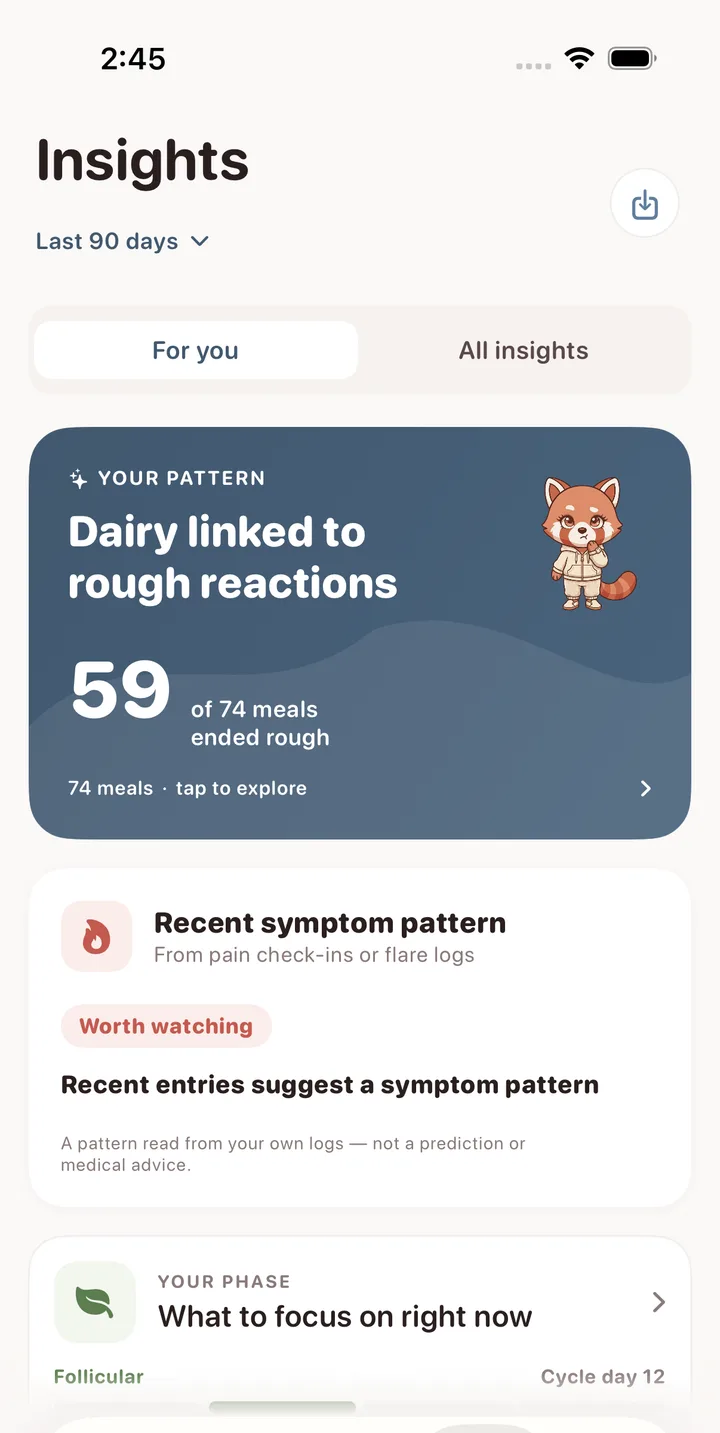
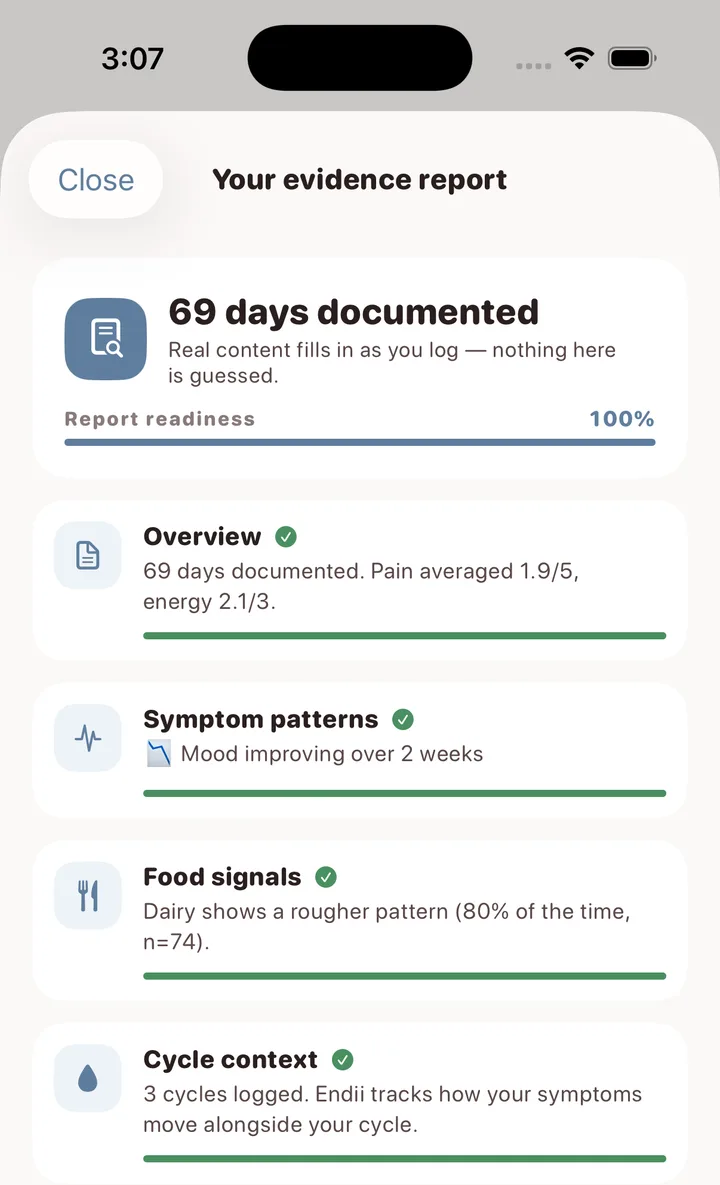
How Endii helps
Endii was built by a woman with endometriosis who was tired of needing three apps to manage one condition.
- Every symptom in one place: pain, tiredness, digestion and anything else you want to log, with your cycle day saved alongside.
- Patterns: see what follows your cycle and what does not.
- Doctor report: a clear PDF of your symptoms and patterns to take to an appointment.
Bring the whole picture to your next appointment.
Endii comes with a 14-day free trial.
Related guides
Sources
- Global Autoimmune Institute. Endometriosis. autoimmuneinstitute.org
- NHS. Endometriosis. nhs.uk
- Mayo Clinic. Endometriosis: symptoms and causes. mayoclinic.org
- World Health Organization. Endometriosis: fact sheet (15 October 2025). who.int
- MedlinePlus, US National Library of Medicine. Autoimmune diseases. medlineplus.gov
- US Office on Women's Health. Endometriosis. womenshealth.gov
- Cleveland Clinic. Endometriosis. my.clevelandclinic.org
- Endometriosis UK. Causes. endometriosis-uk.org
- Endometriosis Foundation of America. Endometriosis: defining it, recognizing it, and treating it. endofound.org
- American College of Obstetricians and Gynecologists (ACOG). Endometriosis: frequently asked questions. acog.org
- Shigesi N, Kvaskoff M, Kirtley S, and others. Human Reproduction Update, 2019. The association between endometriosis and autoimmune diseases: a systematic review and meta-analysis. pmc.ncbi.nlm.nih.gov
- Aziz M, Beaton MA, Aziz MA, Opoku-Anane J, Elhadad N. npj Women's Health, 2025. Endometriosis and autoimmunity: a large-scale case-control study of endometriosis and 10 distinct autoimmune diseases. nature.com
- Gleicher and colleagues, Obstetrics and Gynecology (1987). Is endometriosis an autoimmune disease?. pubmed.ncbi.nlm.nih.gov
- Nothnick, Fertility and Sterility (2001). Treating endometriosis as an autoimmune disease. pubmed.ncbi.nlm.nih.gov
- Eisenberg and colleagues, Autoimmunity Reviews (2012). Is there an association between autoimmunity and endometriosis?. pubmed.ncbi.nlm.nih.gov
- Shigesi and colleagues, Human Reproduction (2025). The phenotypic and genetic association between endometriosis and immunological diseases. pubmed.ncbi.nlm.nih.gov
- University of Oxford. New research reveals shared genetic link between endometriosis and immune conditions. ox.ac.uk
- Endometriosis Australia. Is endometriosis an autoimmune disease?. endometriosisaustralia.org
Sources last checked on 13 November 2026. We link to the page each statement comes from so you can read it in full.
Endii is a tracking journal, not medical advice. It does not diagnose or treat any condition. Always talk to a qualified doctor about your symptoms and before making medical decisions. In an emergency, contact emergency services.