Quick answer
What is stage 4 endometriosis? Stage 4 is the severe category in the staging system of the American Society for Reproductive Medicine. The Endometriosis Foundation of America describes it as many deep implants, large cysts on one or both ovaries, and many dense adhesions.
Being told you have stage 4 endometriosis is frightening. The word "stage" sounds like cancer staging, and four is the highest number.
It helps to know what the number measures, and what it leaves out.
Keep your operation notes, scans and symptoms in one place.
The four stages
The best known staging system comes from the American Society for Reproductive Medicine. It has four stages, described in its patient booklet1:
| Stage | Name | Points |
|---|---|---|
| 1 | Minimal | 1 to 5 |
| 2 | Mild | 6 to 15 |
| 3 | Moderate | 16 to 40 |
| 4 | Severe | More than 40 |
The point ranges are as given by the Endometriosis Foundation of America2. There is no official stage 5.
The four stages, by points on the ASRM scale
What stage 4 means
The Endometriosis Foundation of America describes stage 4 as many deep implants, large cysts on one or both ovaries, and many dense adhesions. Adhesions are bands of scar tissue that can make organs stick together.
The European guideline group ESHRE, in its patient leaflet3, describes stages 3 and 4 as deep endometriosis or cysts on the ovaries, with moderate to extensive adhesions involving the uterus, bowel, ovaries and tubes.
How the stage is decided
The stage is a record of what was seen during surgery. Points are given for where the endometriosis is, how much there is and how deep it goes, for adhesions and how severe they are, and for cysts on the ovaries and their size.
That is why you are usually given a stage after an operation, and why it can only describe that day.
Been given a stage? Keep a dated record of your symptoms in Endii beside it, because the stage does not record how you feel. Free for 14 days, then a subscription.
Get EndiiWhat the stage does not tell you
This is the part most people are never told. ESHRE says the staging system does not predict how severe pain is, or how complex surgery will be. The American Society for Reproductive Medicine says the same: stage does not match the presence or severity of symptoms.
So a person with stage 1 can be in severe pain, and a person with stage 4 can have very little. ESHRE also notes the system was originally designed around fertility, not pain.
Your stage is one fact about you. Your symptoms are a separate set of facts, and they need their own record.
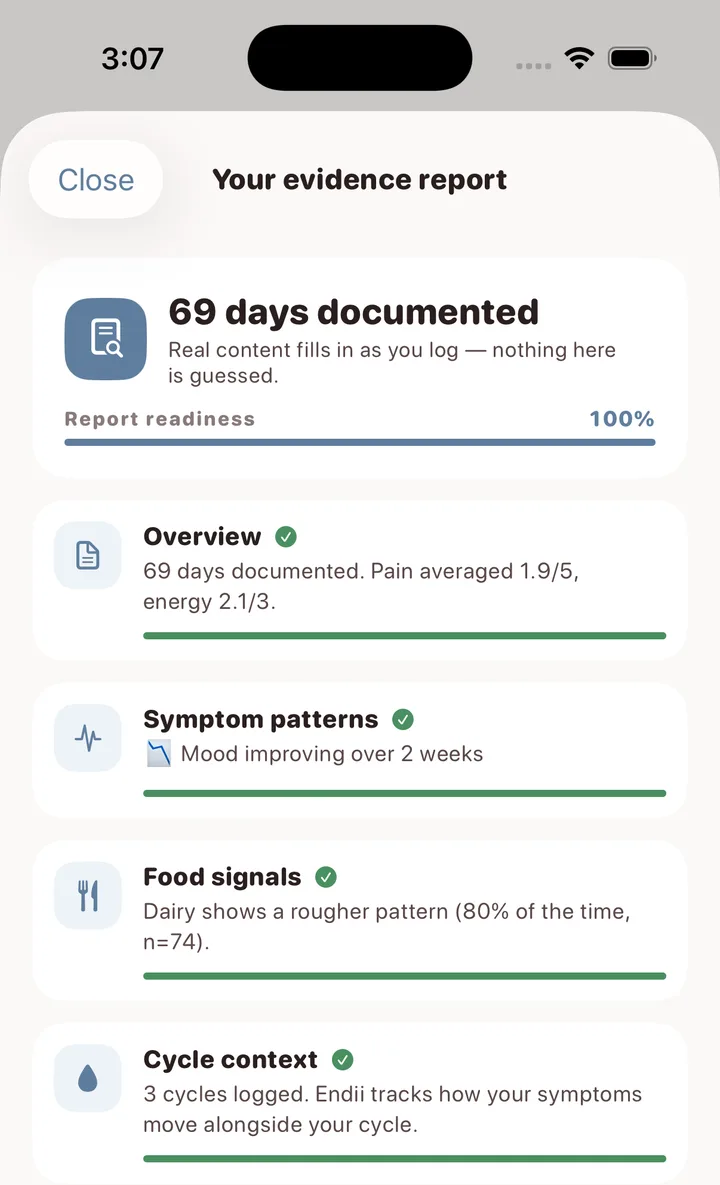
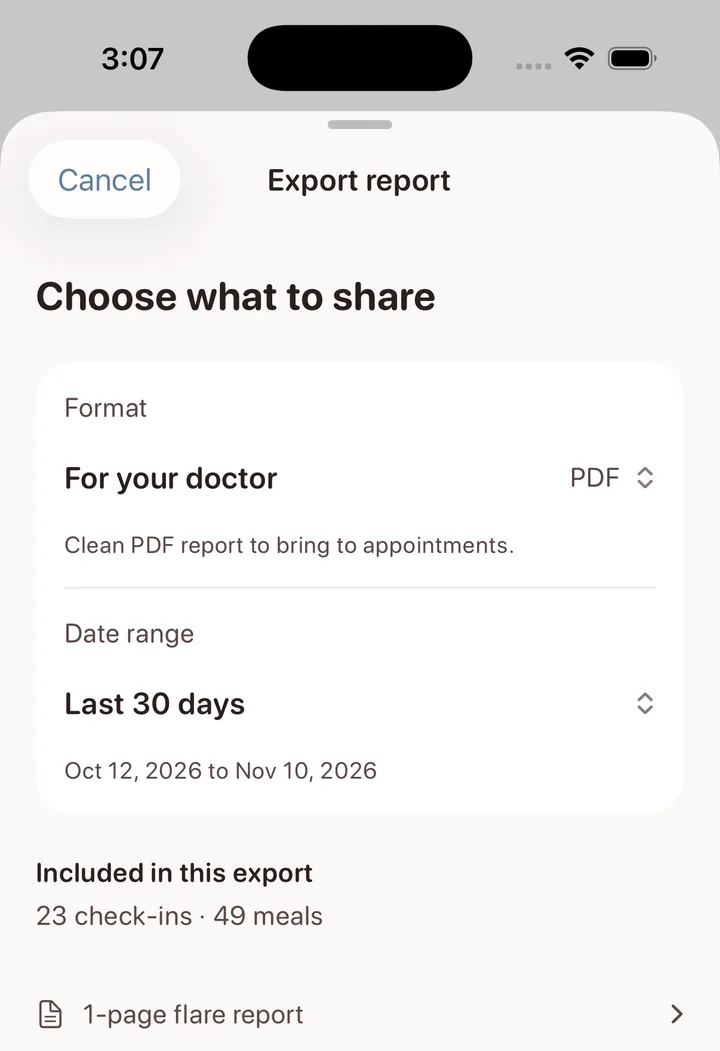
What to keep track of after you are given a stage
- Your operation notes and any scan results. Ask for copies.
- What was found and what was removed
- Your pain and other symptoms, week by week
- Treatments you have tried, with dates and what changed
- Questions for your next appointment
How Endii helps
Endii was built by a woman with endometriosis who was tired of needing three apps to manage one condition.
- Records: store operation notes, scan results and letters on your phone.
- Symptoms and cycle in one place, including a mode for people with no period.
- Treatments tried, with dates, so nothing has to be remembered at the appointment.
- Doctor report: a clear PDF of your symptoms, patterns and history.
Your stage is one fact. Bring the rest too.
Endii comes with a 14-day free trial.
Related guides
Sources
- American Society for Reproductive Medicine (ASRM). Endometriosis: a guide for patients. reproductivefacts.org
- Endometriosis Foundation of America. Stages of endometriosis. endofound.org
- ESHRE. Information for women with endometriosis: patient version of the guideline (2022). eshre.eu
Sources last checked on 10 November 2026. We link to the page each statement comes from so you can read it in full.
Endii is a tracking journal, not medical advice. It does not diagnose or treat any condition. Always talk to a qualified doctor about your symptoms and before making medical decisions. In an emergency, contact emergency services.